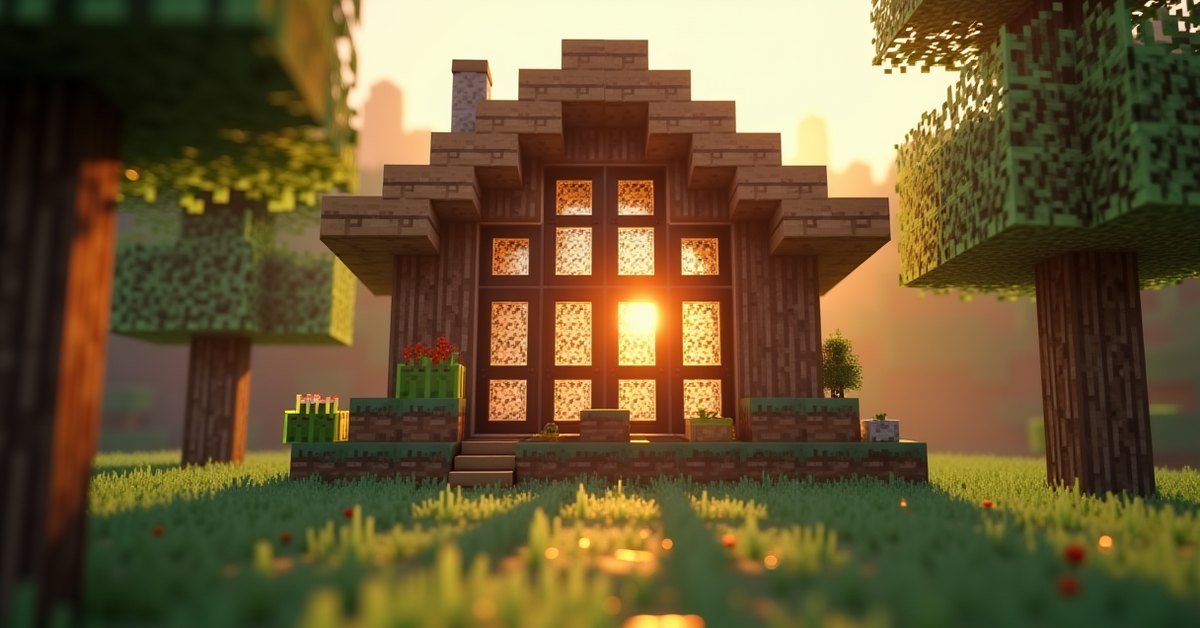
A glass pane in Minecraft is a thin transparent block used mostly for windows. You craft it from glass blocks, place it like any other block, and it connects to its neighbors automatically into a continuous sheet. It’s the standard way to put a real window into a wall instead of using a full glass cube.
Panes pass full daylight, don’t block line of sight, and break almost instantly. They also drop nothing unless you have Silk Touch, so plan ahead if you want to reuse them. Everything else about them (how they connect, how they’re colored, what they don’t do) is covered below.
What is a glass pane?
A glass pane is a thin, transparent block. Visually it looks like a sheet of glass standing upright in a block space, taking up roughly the central two pixels of the block instead of the full cube. Place a few of them in a row and they connect into a continuous sheet, which is why panes are the standard choice for windows in player builds.
Panes share most of the properties of full glass blocks. They are transparent, they pass light through, and they break easily. The differences are shape and connection behavior, and that is where panes earn their slot in a builder’s toolkit.
If you’ve ever tried to make a window with full glass blocks and ended up with a wall that looks too chunky, glass panes are the fix.
How to craft glass panes
Glass panes are crafted from glass blocks at a regular crafting table.
The recipe is simple: fill any two horizontal rows of the 3×3 crafting grid with glass blocks, six total. That produces 16 glass panes. The top and middle rows work, and so do the middle and bottom rows.
To get glass blocks in the first place, smelt sand or red sand in a regular furnace. One sand makes one glass block. Six glass blocks turn into 16 panes, so a single stack of sand goes a long way.
Stained glass panes use the same shape but a colored input. To make them, smelt sand into glass, craft eight glass blocks around one dye to get eight stained glass blocks, then craft six of those stained glass blocks in the pane pattern to get 16 stained glass panes of that color.
How glass panes connect to other blocks
A single glass pane on its own looks like a thin vertical post in the middle of its block space. Place a second pane next to it and they both stretch out to meet, forming a flat sheet between the two block centers. This auto-connecting behavior is the main reason panes look like real windows instead of a row of separate posts.
Panes connect to other glass panes (any color), iron bars, stained glass blocks, tinted glass blocks, and most full solid blocks like stone, wood, and bricks. They do not connect to fences, walls, or non-solid blocks like leaves and tall grass.
The connection rule applies in four directions: north, south, east, and west. Panes don’t stack visually in the vertical direction the way fences do; a pane placed above another pane just sits there, since panes have no top or bottom connections.
If you mix a pane with a fence in the same opening, the pane stays as a single thin post and the fence keeps its own shape. That mismatch is a common visual headache when builders try to combine materials in one window frame.
Stained glass panes and tinted glass
Glass panes come in two color flavors: plain (clear) and stained. Stained glass panes use one of the 16 dye colors and keep the same connecting behavior as regular panes.
The straightforward path to stained glass panes is three steps. Smelt sand into glass blocks. Craft stained glass by placing eight glass blocks around one dye in the crafting grid, which gives you eight stained glass blocks of that color. Then craft those stained glass blocks into panes the same way you craft plain panes: six in two horizontal rows for 16 stained glass panes.
Stained glass and stained glass panes still pass light. The game treats them as fully transparent for lighting purposes, so they don’t drop light level the way most solid blocks would. The color tint mostly shows up on the texture itself and in some shader packs.
Tinted glass is the odd one out. Added with the Caves and Cliffs update, tinted glass is crafted from a glass block surrounded by four amethyst shards. It’s the only glass-family block that fully blocks light. There is no tinted glass pane in vanilla Minecraft; you can’t craft one. If you want a thin, light-blocking divider, you’ll need full blocks of tinted glass or a different material entirely.
Mining glass panes and what they drop
Glass panes break almost instantly with any tool, including bare hands. You don’t need a pickaxe.
What you get back depends on the tool. Plain breaking destroys the pane and drops nothing. A tool enchanted with Silk Touch lets the pane drop itself, ready to place again.
Panes have very low blast resistance. Any nearby creeper, ghast fireball, or TNT will shatter a window wall easily. If your build is in a hostile area, place panes a block back from the exterior so something else absorbs the explosion first.
Practical uses for glass panes
The obvious use is windows. A pane in a wall opening gives you light and a view without the boxy look of a full glass block. Beyond that, panes show up in a lot of builds because they’re thin and transparent and they tile cleanly.
For mob-proof viewing slits, a horizontal row of panes in a one-block gap lets you see out while keeping skeletons from firing arrows reliably and stopping zombies from pathing in. For greenhouses, panes pass full sunlight so crops below them grow at normal speed, and they read lighter visually than full glass blocks across a big roof.
Stained glass panes work well for lighthouse tops and rooftop accents. Surround a beacon or another light source with them and you get a colored glow that reads from a distance. Aquariums benefit too: a pane holds water on the other side and gives a clean, almost invisible viewing window.
Indoors, stained glass panes make a quick partition for shops, hallways, or bedrooms that need a visual break without a full wall. They’re cheap, fast to place, and easy to revise.
Common mistakes to avoid
Glass panes are simple, but a few patterns trip people up.
Mining panes with an unenchanted tool to save them is the most common one. Without Silk Touch you get nothing back, so always check the enchantment before tearing down a window you want to reuse.
Mixing fences and panes in the same opening rarely looks good. They don’t connect to each other visually, so the result is a chunky mess in the window. Pick one or the other for a given gap.
Players sometimes expect a single pane to fill a one-block opening fully. From the side it looks complete, but the pane is centered in its block, leaving a gap on each face when viewed at an angle. For a flush look, use two panes back to back or a full glass block.
Builders also forget that tinted glass has no pane version. If you want a darker window, you’re stuck with full tinted glass blocks or with stained glass panes in a dark color like black or gray.
Finally, placing panes too close to creeper-prone zones is a recipe for repair work. Glass panes have almost no blast resistance, and one creeper at the window can cost the whole wall.
Java and Bedrock differences
Glass panes behave the same way in both editions for the core stuff: crafting recipe, drops, transparency, and connection rules. Minor differences pop up in how stained glass panes can be produced and how panes react to pistons in some edge cases. If you build the same way in both editions, you’ll usually get the same window. The differences are small enough that most players never notice them.
Frequently asked questions
Do glass panes block light?
No. Glass panes pass full light, just like full glass blocks. A torch on one side of a pane wall lights the other side at the same level.
Can mobs spawn on glass panes?
No. Mobs need a solid top surface to spawn on, and panes don’t have one. That makes panes useful as a roof material if you want to prevent mob spawning while keeping the area lit by daylight.
Do glass panes drop themselves when broken?
Only with Silk Touch. Plain breaking destroys the pane and drops nothing.
What’s the difference between glass panes and iron bars?
They share the same thin shape and connection rules, but iron bars are opaque and tougher. Iron bars need a pickaxe to mine and resist fire and creeper blasts much better than glass panes. Panes are transparent and fragile. Use bars where you want security and use panes where you want a view.
Can endermen teleport through glass panes?
A sealed pane wall blocks endermen the same way a solid wall would. They might still teleport above or around the wall if there’s an opening, so a fully enclosed roof matters too. Inside a fully enclosed pane room, an enderman has nowhere to land and won’t end up in the space.
Can I use glass panes underwater?
Yes. Place a pane underwater and it stays in place. The pane itself doesn’t fill the block with water, so panes are a clean choice for holding back water in an aquarium or underwater base. If you break a pane underwater, water flows back into the space.
What’s the cheapest way to make a big window?
Smelt sand into glass, then craft six glass blocks into 16 panes. A single stack of sand becomes more than enough panes for a large picture window. Sand is renewable through wandering trader trades and easy to find on beaches and in deserts, so the real cost is mostly furnace time.
Conclusion
A glass pane is one of the simplest blocks in the game, but it pulls a lot of building weight because it auto-connects and stays transparent. If your next build has a window, a greenhouse, or anything you want to see through without making the wall feel thick, reach for panes before full glass blocks. Keep a Silk Touch pickaxe in your inventory if you’ll be tearing the windows down later.