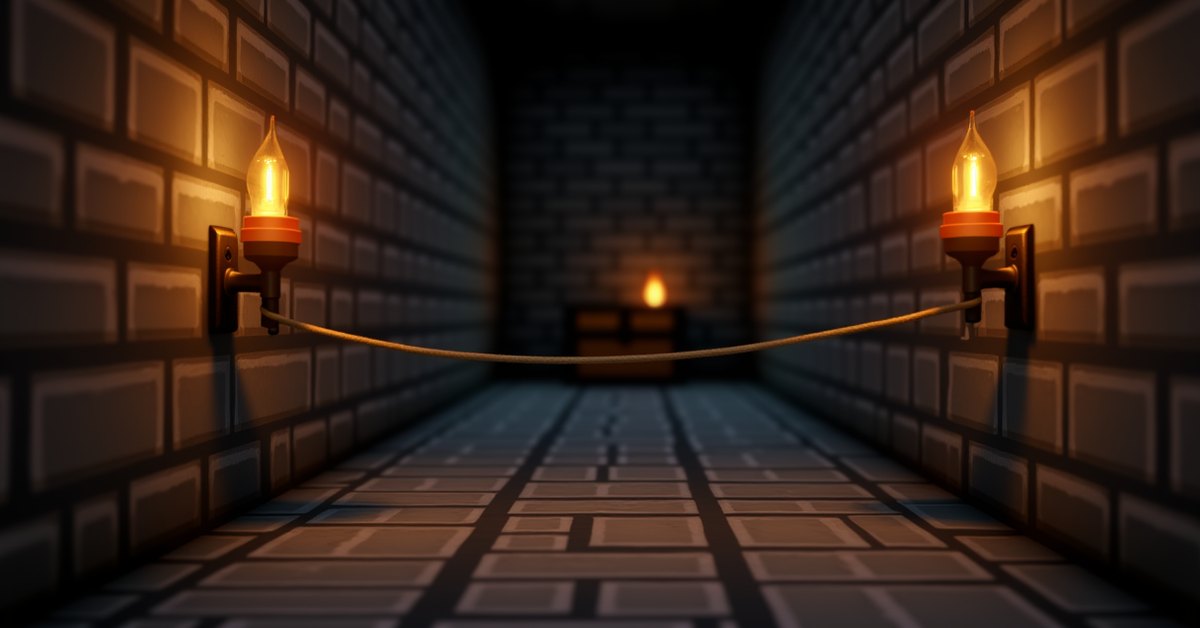
What a tripwire hook does
A tripwire hook is a redstone component that detects when something passes through a piece of string. Place two hooks facing each other on the sides of two solid blocks, connect them with string, and you have a tripwire. The moment a player, mob, minecart, boat, or even a dropped item touches the string, both hooks send a redstone signal of strength 15. As soon as the obstruction leaves the wire, the signal stops.
That makes the hook one of the cheapest motion sensors in the game. It costs less iron than most other detection options, it works across a long horizontal run instead of a single block, and it can be wired into almost anything redstone touches: dispensers, pistons, doors, note blocks, command blocks. If you build traps, hidden doors, or alarms, you will end up using tripwire hooks.
How to craft a tripwire hook
The recipe uses one iron ingot, one stick, and one wood plank. Open a crafting table and place them in a vertical column:
- Top row, middle slot: iron ingot
- Middle row, middle slot: stick
- Bottom row, middle slot: any wood plank
One recipe gives you two hooks. You always need an even number for a working tripwire, so the yield lines up with how the block gets used. Any wood plank works (oak, spruce, birch, jungle, acacia, dark oak, mangrove, cherry, crimson, warped, bamboo), and the resulting hook looks the same no matter which plank you pick.
You can also find tripwire hooks naturally in jungle temples, where they are already wired up to dispensers full of arrows. Mining the hook with any tool drops the hook itself; the string can be collected with shears or a sword.
How to set up a tripwire
A working tripwire needs two hooks facing each other and string filling the space between them. Place the first hook on the side of a block, then stand opposite and place the second hook on a block facing back toward the first. Right-click string onto the floor between them, one block at a time. Once the line connects, both hooks flip into their armed position and the visible string snaps tight.
The string and hooks must all be at the same Y level. You cannot run a tripwire diagonally or step it up and down. The line has to be straight and flat.
The maximum length between two hooks is 40 blocks of string. Anything longer breaks the circuit. Two blocks is the minimum: one hook, one block of string, one hook on the other side.
To pull a redstone signal off the tripwire, place a redstone dust line next to or behind one of the hooks. When the wire is tripped, the dust lights up. You can run that signal anywhere a normal redstone signal goes.
How tripwire hooks work
A tripwire hook has three states: unarmed, armed, and triggered. An unarmed hook sits on the side of a block with no string attached. An armed hook is connected by string to a second hook; both move into a slightly different visual position to show they are live. A triggered hook is an armed hook whose string is currently being touched by an entity.
The redstone output works like this:
- Unarmed hook: signal strength 0
- Armed hook with no entity on the wire: signal strength 0
- Triggered hook: signal strength 15 (full power)
Both hooks in a pair output the signal at the same time, so you can pull power from either end of the wire. The signal lasts only as long as an entity is on the string. Step off and the signal stops.
The wire triggers for any entity whose hitbox crosses the string block. That includes players (sneaking or not), mobs, dropped items falling through the line, arrows that lodge in a tripwire block, minecarts, boats, and fishing bobbers that land on the wire. Items resting on top of a block next to the string do not trigger it; only contact with the string itself counts.
Sneaking does not bypass a tripwire. This trips up new players who assume crouch lets them slip past, the way it does with some pressure plate setups. It does not. If you cross the string, you trigger it.
How to disarm a tripwire
The clean way to disarm a tripwire is to break the string with shears. Shears cut the string silently without sending a signal, and the string drops as an item you can pick up. Without shears, you can punch the string with a sword or your fist, but that will trigger the wire on the way out, which fires whatever the hooks are wired to.
A second method: mine the block of dirt, stone, or whatever the hook is mounted on. Removing the support block detaches the hook, and the circuit goes dead. The hook drops as an item. This works if you want to keep the string in place for later reuse.
You can also break a single hook without touching the string. As soon as one hook leaves the wall, the wire is no longer a complete circuit and the other hook drops out of the armed state.
If you find a tripwire in a jungle temple and you want to keep the loot intact, shears are the only reliable answer. Anything else triggers the dispensers.
What to build with tripwire hooks
The classic build is a trap. Place a tripwire across a doorway, tunnel, or chest room. Wire one hook through a redstone line to a dispenser loaded with arrows, splash potions of harming, or fire charges. Anyone who walks through gets hit. Switch the dispenser for TNT if you want a one-shot demolition trap, but be aware that TNT also destroys whatever the hooks were attached to.
Hidden doors use tripwire as a stealth lever. Run a tripwire across the floor of a hallway, hide the hooks inside the wall by tucking them behind blocks, and connect the redstone output to a piston door. Walking down the hallway opens the door without any visible switch.
Alarms work the same way, just with note blocks or bells on the output side. Tripwire near your front door, note block in the basement: instant intruder warning when you are mining underground.
Sorting and counting systems use tripwire less often than hoppers and comparators, but it can detect when a player walks past a specific point. That is useful for one-shot triggers, like a starting line for a parkour course or a checkpoint in an adventure map.
Mob farms occasionally use tripwire to detect when mobs land in a kill chamber, though pressure plates and observers handle that role more often.
Common mistakes to avoid
Most tripwire problems come from misreading the setup, not from a bug.
If your tripwire never triggers, check that both hooks are at the same height and facing each other. Hooks placed on opposite walls have to point inward toward the string, not outward.
If the wire looks placed but the hooks never armed, the line between them is broken. A single missing string block kills the circuit. Walk it end to end and look for gaps.
If the wire is too long, it will not work. The 40-block string limit between hooks is a hard cap. Use two separate tripwires in series with a redstone repeater between them if you need to cover more ground.
If you destroy the support block under a hook, the hook pops off and the wire dies. Build hooks into permanent walls, not into a row of grass blocks that a sheep might eat.
Pistons interact with hooks. A piston pushing a hook will pop the hook off the block. If your build has nearby pistons, leave a buffer so the hook stays put.
Java and Bedrock differences
Tripwire hooks behave almost identically across both editions. The recipe, the placement rules, the trigger conditions, and the redstone output are the same.
Arrows stuck in a tripwire string activate the wire on both editions. The trigger lasts as long as the arrow stays in the string, which is typically a few seconds before the arrow despawns or is collected.
Crafting yields are also identical on both editions: two hooks per recipe.
Frequently asked questions
Can you sneak past a tripwire?
No. Crouching does not let you cross a tripwire string without triggering it. The only safe way past an armed wire is to cut the string with shears or break a hook.
Do arrows trigger tripwires?
Yes, on both Java and Bedrock. An arrow that lodges in a tripwire string activates the hooks for as long as the arrow stays there.
What is the maximum tripwire length?
40 blocks of string between two hooks. Anything longer breaks the connection and the hooks will not arm.
Can mobs trigger tripwires?
Yes. Any entity with a hitbox touching the wire triggers it, including hostile mobs, passive mobs, and items in motion through the string.
How do you break a tripwire without setting it off?
Use shears on the string. Shears cut the line silently and drop the string as an item. Punching the string with a sword or fist will trigger the wire before it breaks.
Why is my tripwire hook not arming?
The line between the two hooks has a gap, the hooks are not facing each other, or the hooks are at different Y levels. Check each block of string in the run.
Can you craft tripwire hooks without iron?
No. The recipe requires one iron ingot per pair. There is no alternative crafting path. If you are out of iron, look for tripwire hooks in jungle temples instead.
Final tip
Always carry shears when exploring jungle biomes. A tripwire in a jungle temple is wired to dispensers full of arrows, and cutting the string with shears lets you walk in, take the loot, and reuse the hooks and string on your own builds back home.