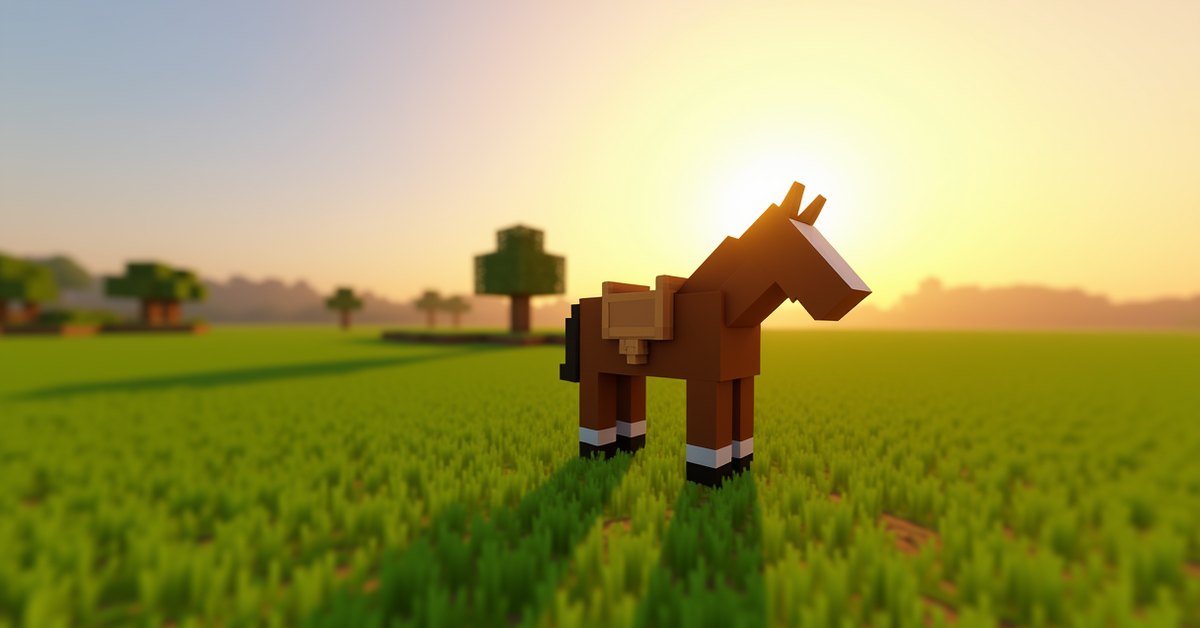
What is a horse in Minecraft?
A horse is a passive mob you can tame, ride, and breed. Once you put a saddle on a tamed horse, it becomes the fastest reliable way to cross land in survival, faster than sprinting and far less work than building roads or rails.
Horses spawn in herds out in the open, and no two are exactly alike. Each one rolls its own speed, jump height, and health when it spawns, so part of the fun is finding a good one and making it yours.
This guide covers where to find horses, how to tame one, how to saddle and armor it, how breeding works, and the small mechanics that trip people up.
Where to find horses
Horses spawn in flat, grassy biomes: plains, sunflower plains, savanna, and meadows. They show up in small groups of two to six, and the horses in a single herd often share a similar coat color.
You can also find horses inside village animal pens, and a few generate in specific structures. If you are hunting for a fast one, the quickest approach is to gather several horses in one place, tame them, and compare. More on that below.
Coat colors and markings
Horses come in seven base colors: white, creamy, chestnut, brown, black, gray, and dark bay. On top of the base color, each horse can carry one of several marking patterns, such as white socks, a white blaze, spots, or a sooty shading. The look is cosmetic and has no effect on stats, so a plain brown horse can easily outrun a flashy spotted one.
How to tame a horse
Taming a horse takes patience instead of food. Walk up to a wild horse with an empty hand, then mount it. The horse will buck you off almost immediately. Get back on, get thrown again, and keep repeating. Each attempt has a chance to tame it, and when hearts appear above the horse, it is yours.
Feeding the horse before you start helps. Sugar, wheat, apples, and especially golden apples and golden carrots raise the horse’s temper, which makes each mount attempt more likely to succeed. A hay bale also restores a lot of health and is handy for a hurt horse.
A tamed horse will let you ride it, but you still cannot steer it yet. For that you need a saddle.
Saddling and riding
A saddle is the one item a horse cannot do without if you want to control where it goes. You cannot craft a saddle. You find them in chests in dungeons, temples, mineshafts, and other loot spots, get them from fishing, or buy them from a leatherworker villager.
To equip the saddle, mount your tamed horse and open your inventory. You will see the horse’s own inventory with a saddle slot. Drop the saddle in, and now your movement keys steer the horse. Press the jump key to make it leap, and hold it to charge a higher jump if the horse has the strength for it.
Horses can climb single blocks like stairs, swim through water (you stay mounted but cannot control them well in deep water), and take reduced fall damage compared to a player. They cannot fit through a one-block-wide gap, so build doorways and paths at least two blocks wide if you plan to stable them.
Horse stats: speed, jump, and health
Every horse spawns with three hidden stats rolled at random:
- Movement speed, which ranges widely from a slow plod to roughly three times a player’s sprint.
- Jump strength, which determines how high the horse can leap, from a little over one block up to more than five blocks.
- Health, measured in the usual hearts, with stronger horses having close to double the hearts of weak ones.
Because these are random, the only way to know what a horse can do is to test it or breed for it. A common trick is to tame several horses, saddle them one at a time, and race them across flat ground or jump them over a wall of a known height. Keep the best, release or repurpose the rest.
Horse armor
Horse armor protects your mount from damage, which matters once you start riding into dangerous areas. It comes in four tiers: leather, iron, gold, and diamond, in increasing order of protection.
You equip it the same way as a saddle. Mount the horse, open the inventory, and place the armor in the armor slot next to the saddle. Leather horse armor can be dyed almost any color if you want to match a build or a team, while the metal tiers keep their metallic look. Horse armor is not consumed and does not wear out, so once a horse has diamond armor it keeps that protection for good.
One thing to note: donkeys and mules can carry a chest but cannot wear armor, while regular horses can wear armor but cannot carry a chest. Pick the animal that fits the job.
Breeding horses
Breeding is how you build a genuinely great horse instead of relying on luck. Feed two tamed horses a golden apple or golden carrot each, and they enter love mode and produce a foal.
The foal’s stats are not a simple copy of either parent. The game averages the two parents and adds a third random roll, then blends them together. In practice this means breeding two fast, high-jumping horses tends to give you a foal that is fast and jumps well, sometimes better than either parent. Breed your two best horses, keep the best foal, and repeat across a few generations to push toward the upper limits.
A foal takes a while to grow into an adult on its own. You can speed that up by feeding it, with each feeding shaving time off its growth. Once grown, tame it like any other horse and put it to work.
Donkeys, mules, and hybrids
Donkeys breed with horses to produce mules, which are sterile and cannot breed further. Donkeys and mules are slower than a good horse but carry a chest, which makes them mobile storage for long trips. If you want both a riding horse and a pack animal, keep a fast horse and a donkey rather than trying to get one animal to do everything.
Tips and common mistakes
Use a lead to bring a horse home. A wild herd rarely spawns near your base, so clip a lead on a tamed horse and walk it back, or tie it to a fence post while you build a stable. You can also load a horse into a boat to ferry it across water.
Name your favorite horse with a name tag. Tamed horses do not despawn, but a name tag protects against accidental loss and makes a special horse easy to spot. Keep a hay bale or two in your stable as well, since one bale heals a horse quickly after a rough ride.
Watch out for skeleton horses and zombie horses, which are separate mobs and not the same as regular horses. Skeleton horses appear in a “skeleton trap” during thunderstorms, where lightning strikes a lone skeleton horse and spawns skeleton riders. Approach those carefully.
Frequently asked questions
How do you tame a horse in Minecraft?
Approach a wild horse with an empty hand and mount it repeatedly. It will throw you off each time until hearts appear, which means it is tamed. Feeding it sugar, apples, or golden carrots first makes taming faster.
Do you need a saddle to ride a horse?
You can sit on a tamed horse without a saddle, but you cannot steer it. A saddle is required to control the horse’s direction and to make it jump on command.
What do horses eat?
Horses eat sugar, wheat, apples, golden apples, golden carrots, and hay bales. Golden apples and golden carrots are the only foods that trigger breeding, and hay bales restore the most health.
How do I get a faster horse?
Speed is random per horse, so tame several and test them, then breed your two fastest together with golden carrots or golden apples. The foal often ends up faster than either parent, and a few generations of selective breeding gets you close to the maximum.
Can horses wear armor?
Yes. Regular horses can wear leather, iron, gold, or diamond horse armor, which you equip through the horse’s inventory. Donkeys and mules cannot wear armor but can carry a chest instead.
Do tamed horses despawn?
No. Once a horse is tamed it will not despawn, even without a name tag. Naming it with a name tag is still a good habit for a horse you care about.
Worth taming a good one
A random wild horse will get you moving, but a bred-up horse with high speed and a tall jump changes how you play, turning long overland trips into quick rides and letting you clear walls and ravines that would stop you on foot. Tame a few, breed the best, and keep the foal that surprises you.