A village is a group of buildings where villagers live, work, and trade. Find one early and it changes how your whole game goes: free food from the farms, a bed to skip the night, and a population of traders who will hand you enchanted books, armor, and tools for emeralds.
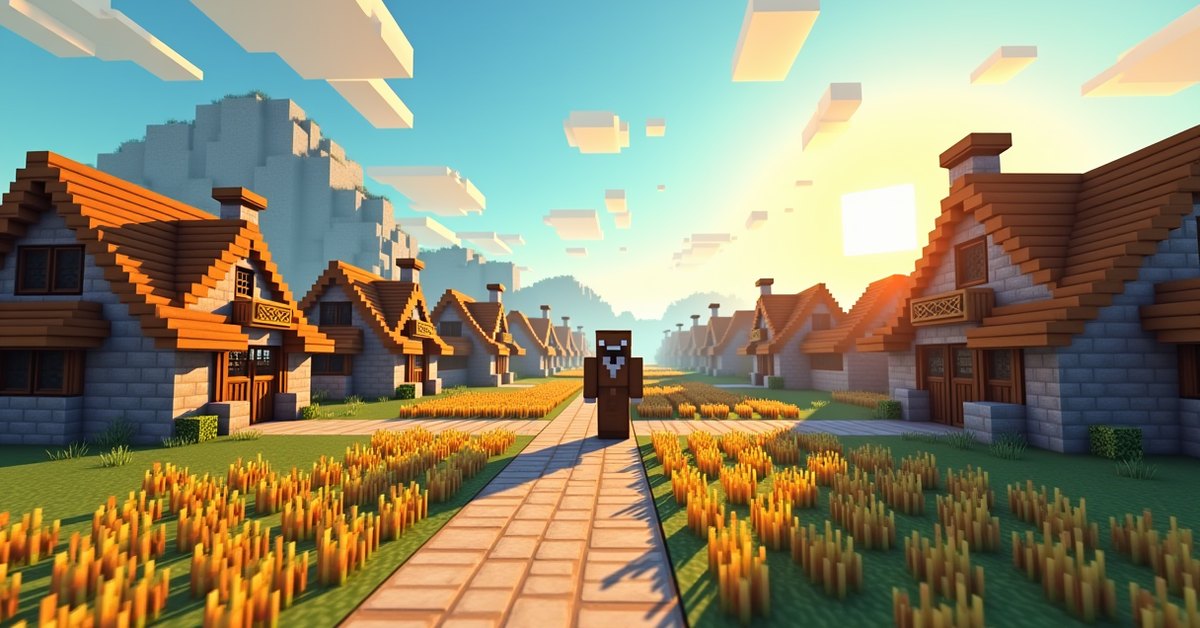
Villages generate on their own as the world loads, so no two look quite the same. Some are a handful of houses around a well. Others sprawl across a hillside with dozens of buildings, farms, and paths. This guide covers where they spawn, what you’ll find inside, and how to turn a village into one of the most useful things in your world.
Where villages spawn
Villages only generate in a specific set of biomes, and the building style changes to match the biome it lands in. If you’re hunting for one, head to open, flat terrain first. Plains and savanna villages are the easiest to spot because the land around them is clear.
The biomes that generate villages are plains, sunflower plains, meadow, desert, savanna, taiga, and snowy plains. Each one has its own look:
- Plains and meadow villages use oak, cobblestone, and hay, with a bright, classic look.
- Desert villages are built from sandstone and have flat roofs to fit the biome.
- Savanna villages use acacia wood, giving them an orange tint.
- Taiga villages use spruce and stone, with steep roofs.
- Snowy villages use spruce and snow, and often include igloo-style touches.
A village needs enough flat ground to generate, so mountains, thick forests, and oceans won’t have them. If you spawn in a rough biome, walk toward flatter land and you’ll usually run into one. On a new world you can also start a fresh world a few times, since many seeds place a village close to spawn.
What’s inside a village
Every village is built from a set of pieces stitched together by the game. You won’t see all of these in every village, but most show up somewhere:
- Houses where villagers sleep. Beds inside them set the village’s population cap.
- A meeting point marked by a bell. Villagers gather here during the day and run to it when danger appears.
- Farms growing wheat, carrots, potatoes, and beetroot. You can harvest these freely.
- Job site blocks like composters, lecterns, and blast furnaces that give villagers their professions.
- Wells, paths, and lampposts that connect the buildings.
- Animal pens holding cows, sheep, pigs, or other livestock.
The bell is worth knowing about. Ringing it makes nearby villagers rush indoors, which is handy if you want to trap or count them. It also marks the center that iron golems patrol.
Villagers and their jobs
Villagers are the whole point of a village. Each one either has a profession, is a jobless nitwit, or is unemployed and looking for work. An unemployed villager claims a job the moment it finds an unclaimed job site block nearby.
The job comes from the block, so you can steer a villager into any profession by placing the matching block next to it. Here’s how the professions line up with their blocks:
| Profession | Job site block |
|---|---|
| Farmer | Composter |
| Librarian | Lectern |
| Cleric | Brewing stand |
| Armorer | Blast furnace |
| Toolsmith | Smithing table |
| Weaponsmith | Grindstone |
| Fisherman | Barrel |
| Fletcher | Fletching table |
| Shepherd | Loom |
| Butcher | Smoker |
| Leatherworker | Cauldron |
| Mason | Stonecutter |
| Cartographer | Cartography table |
A nitwit wears green robes and never takes a job, so it’s the one villager you can’t put to work. If you’re building a trading setup, breed past the nitwits or move them out.
If you break a villager’s job site block, it loses the profession (unless it has already traded with you and locked in). Place a different block and it can pick up a new job. This is how players farm for the exact trades they want.
Trading with villagers
Trading is the reason experienced players guard villages so carefully. Emeralds are the currency, and villagers both buy and sell. A farmer will buy your extra wheat for emeralds, then a librarian will sell you an enchanted book for those same emeralds.
Each villager has five career levels: novice, apprentice, journeyman, expert, and master. Trading with them fills an experience bar, and every level up unlocks new trades and better ones. A master-level librarian or armorer is one of the strongest sources of gear in the game.
Librarians get the most attention because they sell enchanted books, including top-tier ones like Mending. If a librarian’s book trade isn’t what you want, break and replace its lectern to reroll the offers, as long as you haven’t traded with it yet. Once you make a trade, that villager’s offers are locked.
Villagers restock their trades by working at their job site, usually twice a day. If you’ve bought out a trade, leave the villager alone for a while and let it walk to its block to refill.
Iron golems and cats
A village with enough villagers and beds will spawn an iron golem on its own. Golems patrol the village and attack zombies, pillagers, and other threats. They won’t hurt you unless you hit a villager and lower your reputation enough to make them hostile.
Cats also spawn in villages, one per few beds up to a cap. A village cat can be tamed with raw fish, and a tamed cat will sometimes bring you gifts when you wake up. Cats also scare away creepers and phantoms, so keeping one around your base has real value.
Threats: zombies and raids
Villages attract danger. At night, zombies path toward villagers and try to break down doors on higher difficulties. A zombie that kills a villager can turn it into a zombie villager instead. You can cure a zombie villager by hitting it with a splash potion of Weakness and then feeding it a golden apple, which takes a few minutes but gives you your villager back, often with better trade prices.
The bigger threat is a raid. If you walk into a village while you have the Bad Omen effect, the game triggers a raid: waves of pillagers, vindicators, evokers, witches, and ravagers spawn and attack the villagers. You pick up Bad Omen by killing a raid captain, the pillager carrying a banner on its head, out in the world.
Clearing every wave gives you the Hero of the Village effect, which drops trade prices across the whole village for a while. It’s one of the best times to stock up on emeralds’ worth of gear. If you’re not ready for a fight, drink a bucket of milk to clear Bad Omen before you enter the village, and no raid starts.
Growing and building your own village
You don’t have to rely on what the game generates. Villagers breed when they’re willing, and willingness comes from food. Give villagers plenty of bread, carrots, potatoes, or beetroot, make sure there are enough valid beds nearby, and pairs of villagers will produce baby villagers to fill the empty beds.
This is how players build trading halls: gather a few villagers, supply food and beds, and grow the population until you have one of every profession you need. Because job site blocks control professions, a hall of your own design gives you far more control than a wild village ever will.
Two rules keep a home village healthy. Light it up so hostile mobs can’t spawn inside and pick off villagers, and wall it or fence it off so nothing wanders in. A well-lit, enclosed village with iron golems patrolling is close to self-defending.
Tips and common mistakes
A few things trip up new players. Don’t hit villagers for fun, since your reputation drops and golems can turn on you. Don’t let a villager stand next to a job block you didn’t mean to give it, or you’ll get the wrong profession. And don’t leave a rescued village dark, because one night of zombies can undo all your work.
On the useful side: carry a bed and a job block when you travel, so you can start a pop-up trading post anywhere. Move a librarian into a small cell with a lectern and you have a portable enchanted-book shop.
Java and Bedrock differences
The core of villages works the same on both editions, but a few details differ. Raid mechanics, iron golem spawn timing, and the exact math behind villager willingness aren’t identical between Java and Bedrock. Trade rerolling by breaking a lectern works on both, though the feel differs slightly. If a specific villager trick isn’t behaving the way a video showed, check whether that video was made on the other edition.
Frequently asked questions
How do I find a village fast?
Head to plains, savanna, or desert biomes, where the open ground makes villages easy to spot. On a fresh world, many seeds put a village within a short walk of spawn.
Can I sleep in a village bed?
Yes. Village beds work like any bed you place. Sleeping in one also sets your spawn point, so a village makes a convenient early base.
Why did my villager lose its job?
Breaking its job site block removes the profession, as long as the villager hasn’t locked in a trade with you yet. Place the block back, or a different one, and it can take a new job.
How do villagers get emeralds to trade?
They don’t need a stockpile. Villager trades work off a fixed set of offers, and they restock by working at their job site block a couple of times a day.
What triggers a raid?
Entering a village while you have the Bad Omen effect. You get Bad Omen by killing a pillager captain, which is the one carrying a banner. Drink milk to remove the effect if you want to avoid the fight.
Can I move villagers to a new location?
Yes, though it takes patience. Push them with boats or minecarts, or lead them along with beds and job blocks. Many players relocate a few villagers to build a controlled trading hall.
Start small
The fastest way to learn villages is to claim one and fix it up. Light the buildings, count the beds, and try a few trades to see what your villagers offer. Once you understand how jobs and trading connect, a single village can supply your enchanted gear for the rest of the world.