What farmland is
Farmland is the block you make by using a hoe on dirt, grass, or a few related blocks. It’s the only block that wheat, carrots, potatoes, beetroot, melons, and pumpkins will grow on. Without farmland, you can’t farm anything except a handful of edge-case plants like nether wart and bamboo.
Farmland looks like dirt with a tilled top. When water reaches it, the texture turns darker and crops planted on it grow faster. When a player or mob jumps on it, the block reverts to plain dirt and any crop on top pops off as an item.
If you’ve ever lost a row of wheat because you took a shortcut across your field, you’ve already met the most important rule of farmland: walk around it, not on it.
How to make farmland
To make farmland, hold any hoe and right-click (on Bedrock, tap the block with the hoe equipped) on the top of one of these blocks:
- Dirt
- Grass block
- Coarse dirt (becomes regular dirt first, then farmland on a second use)
- Dirt path
- Rooted dirt (becomes regular dirt first)
You can’t make farmland from mud, podzol, mycelium, or moss block. You also can’t till a block that has another block sitting directly on top of it. If a torch or a piece of wheat is already on the dirt, the hoe will not turn it into farmland; clear the top first.
Any hoe works. A wooden hoe tills as fast as a netherite hoe. The only real difference between hoe tiers is durability. The hoe loses one durability point per till, so a wooden hoe will get through about 60 blocks before breaking, while a netherite hoe handles over 2,000.
Hydration and water range
Farmland has a hidden moisture level from 0 to 7. A moisture of 7 is called hydrated, and the block displays its darker, wet-looking texture. A moisture of 0 is fully dry and shows the lighter texture.
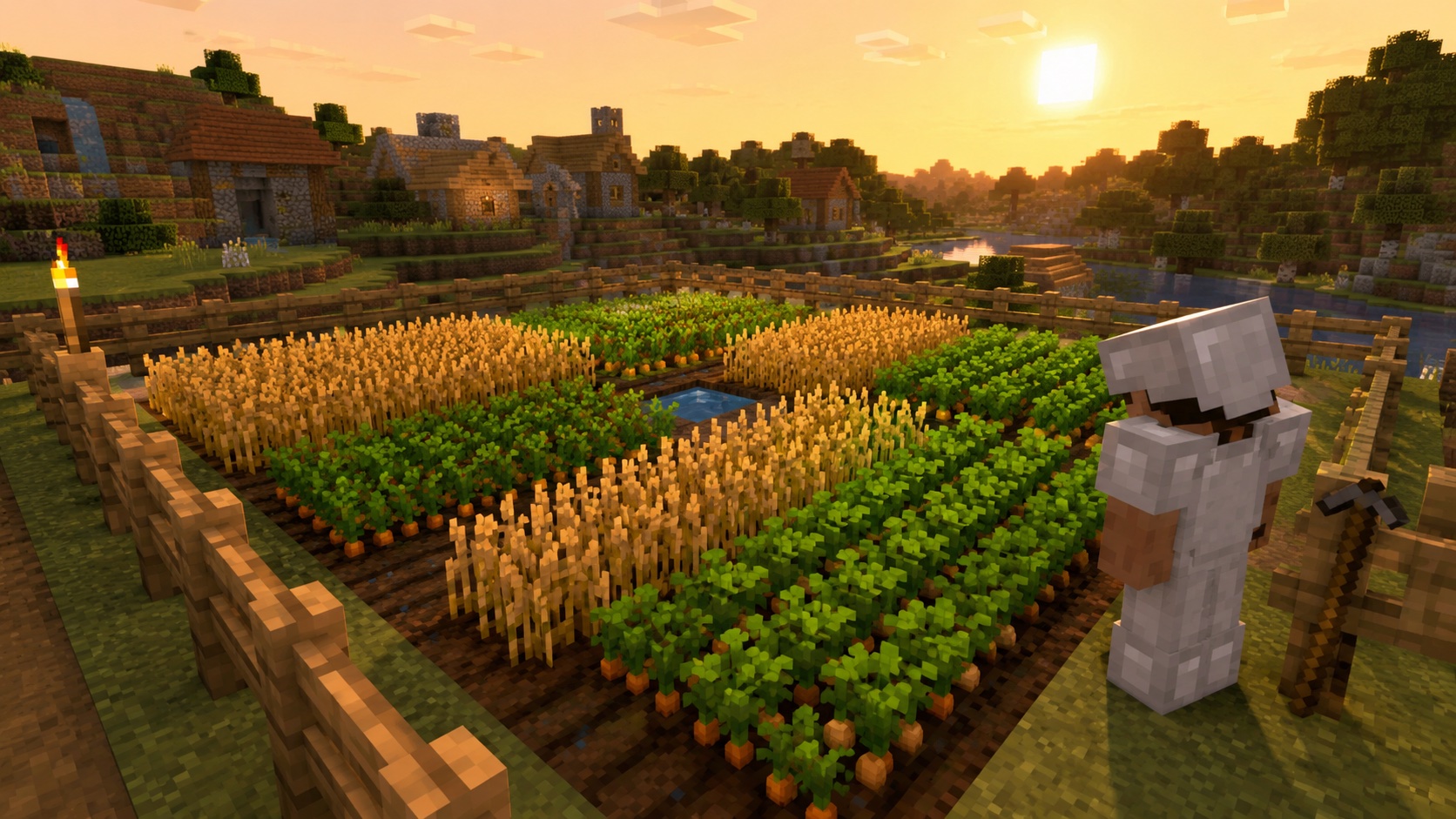
To hydrate a farmland block, place a water source (or flowing water connected to one) within 4 blocks horizontally and 1 block above. Diagonals count. A single water source in the middle of a 9×9 field hydrates every block in that field, which is why “9×9 with a water hole in the center” is the standard farm layout.
A waterlogged block, like seagrass or kelp in a real water source, also hydrates farmland. Frosted ice doesn’t. Ice and packed ice don’t either, since they aren’t water in the game’s eyes.
If you remove the water, the moisture level ticks back down over time. Dry farmland will not pop your crops off by itself, but it slows growth and will revert to dirt if no crop is planted on it.
Growing crops on farmland
Crops need three things to grow:
- Farmland under them
- Light level 9 or higher on the block where the crop sits
- Random ticks (the game ticking the block over and over)
Light can come from the sun or from a light source like a glowstone block. A jack o’lantern, a torch right next to the crop, or a shroomlight all push the level above 9 nearby. Sunlight gives a flat 15 during the day, which is plenty.
Each random tick gives a crop a chance to grow one stage. Hydrated farmland gives a higher chance per tick than dry farmland. In practice, a wheat plant on hydrated farmland with neighbors arranged well will reach full growth in roughly a tenth of the time it takes on dry, unoptimized ground.
Crops also grow faster when planted in alternating rows of different types, or in single rows separated by empty farmland. Planting four rows of wheat next to each other slows everything down, because the game checks neighbor crops to decide growth speed. The optimal field has wheat-empty-wheat-empty or wheat-carrot-wheat-carrot rows.
What you can plant on farmland
These crops require farmland:
- Wheat (from wheat seeds)
- Carrots
- Potatoes
- Beetroot (from beetroot seeds)
- Melon stems (from melon seeds)
- Pumpkin stems (from pumpkin seeds)
- Torchflowers (from torchflower seeds)
- Pitcher plants (from pitcher pods)
Nether wart doesn’t. It only grows on soul sand. Sweet berry bushes grow on dirt or grass, not farmland. Cocoa beans grow on the side of jungle logs. Bamboo grows on dirt, grass, sand, or mycelium, never farmland.
One quirk to know: pumpkins and melons grow on the dirt or grass next to their stem, not on the farmland itself. The stem sits on farmland, but the fruit block needs an open, non-farmland block beside it to spawn. If you’re getting full-grown stems with no fruit, the issue is usually that your stems are crowded together with no clear space next to them.
Trampling and how to prevent it
Any entity that falls onto farmland from a height of 0.625 blocks or more can trample it. A normal player jumping straight up and coming down on farmland will trample it. Falling from one block above will trample it. Walking across at normal pace will not.
When farmland gets trampled, it converts back to dirt and the crop on top drops as an item. You lose the growth time, but you keep the seeds and any other drops, so it isn’t a total loss.
The common ways to protect farmland:
- Place fences, walls, or fence gates around the field so mobs can’t path onto it.
- Cover the field with carpets, slabs, or pressure plates. Walking on these does not trample the farmland underneath.
- Light it well so hostile mobs don’t spawn on it at night.
- Don’t jump in your own field. Crouch-walk (shift) when harvesting if you’re nervous about accidental jumps.
Cows, sheep, pigs, and other passive mobs are heavy enough to trample if they jump, which they do when bred or pushed against a fence. A solid fence around the field keeps them out. Iron golems can trample too, so don’t path them through your crops.
Tips and common mistakes
A few things that catch newer players:
- The 9×9 layout exists for a reason. Water hydrates 4 blocks in every direction. A 9×9 square with a single source in the middle gives the most farmland per water source.
- Light your field at night. Crops keep growing in the dark as long as the light level on the crop block is 9 or higher. Glowstone or a few torches in the corners is enough.
- Don’t till right next to a cliff. If you fall off and land on your own farmland, you trample everything you walked over.
- Bone meal still works on every crop. Bone meal grows the crop a random number of stages per use, and it doesn’t require hydrated farmland to take effect.
- Villagers will harvest and replant. If a farmer villager has line of sight to a field, they will collect ripe crops and plant new seeds. A composter nearby turns this into a real village job site and gives you trade access.
- Don’t waste hoe durability on coarse dirt at the start. You can till it, but it takes two passes, so regular dirt is faster on a wooden hoe.
Java vs Bedrock differences
The mechanics of farmland are nearly identical on Java and Bedrock. The two real differences:
- On Bedrock, jumping on farmland is slightly more forgiving in terms of trampling thresholds, but the difference is small enough that you should still treat any jump as a trample risk.
- Bedrock allows tapping the block with a hoe equipped to till; Java requires a right-click. Controllers on Bedrock map this to the left trigger or the action button depending on the platform.
Crop growth rates feel similar in practice. Both editions use the same neighbor-based growth bonus and the same light requirement, and both reset farmland to dirt under the same conditions.
Frequently asked questions
Can you walk on farmland without ruining it?
Yes, as long as you don’t jump. Walking does not trample farmland on its own; only falling onto it from 0.625 blocks or higher does. The safe move is to crouch-walk (shift) across a field, which prevents you from accidentally jumping.
How do you get farmland in your inventory?
You can’t, not through normal play. Breaking farmland always drops dirt, even with a silk touch tool. The only way to place farmland as a block is to till another dirt block with a hoe. Creative mode players can get it through the creative menu or with the /setblock command.
Why does my farmland keep turning back to dirt?
Two reasons. Either you’re trampling it by jumping or falling, or it dried out and had no crop on it. Dry, empty farmland reverts to dirt over time. Plant a crop or keep it hydrated and it stays as farmland forever.
How far does water hydrate farmland?
Four blocks horizontally in any direction, including diagonals, and one block above. That’s why a single water source in a 9×9 field is enough. The water has to be a true source block or flowing water connected to one.
Does a hoe’s material affect tilling speed?
No. Wood, stone, iron, gold, diamond, and netherite hoes all till at the same speed. Higher tiers only give you more durability. A gold hoe enchants well but breaks fast; a netherite hoe lasts the longest.
Can mobs trample farmland?
Yes. Any mob that jumps or falls onto a farmland block from at least 0.625 blocks up can trample it. Rabbits even eat carrots, so they trample farmland during their snack runs. Fences keep most mobs out of a field.
Do crops grow faster on hydrated farmland?
Yes, noticeably. Each random tick on a hydrated block has a higher chance to advance the crop one growth stage. A field with water in it can roughly double the speed compared to a dry field of the same size and layout.
Can you put farmland in the nether?
You can take farmland into the nether with /setblock or by tilling dirt you carried in, but you can’t hydrate it. Water evaporates in the nether, so your farmland will stay dry. Crops still grow on dry farmland, just slower, and the nether biome doesn’t get natural sunlight, so you’ll need torches or glowstone for the light level.