
Updated for Java Edition 26.3 (October 2026).
The creaking is a hostile tree-like mob from the pale garden, added in Java Edition 1.21.4 (The Garden Awakens, December 2024). It only moves when no one is looking at it, and you can’t kill it by hitting it: it is bound to a creaking heart hidden in a nearby pale oak tree, and breaking that heart is the only way to get rid of it. Creakings appear at night and vanish at dawn.
| Type | Hostile mob |
|---|---|
| Spawns from | A creaking heart in a pale oak tree, at night |
| Found in | The pale garden |
| Attack | 3 damage (1.5 hearts) |
| How to kill it | Break its creaking heart; hitting the creaking itself doesn’t hurt it |
| Drops | Hitting it makes its heart produce 2 to 3 resin clumps |
| Weakness to exploit | It freezes while you look at it; a carved pumpkin on your head stops that |
| Added in | Java Edition 1.21.4 (The Garden Awakens, December 3, 2024) |
How the creaking behaves
A creaking wakes up when a player in Survival or Adventure mode is within 12 blocks and looks at it, and it stays active while any such player is within 32 blocks. Once it’s active, it only moves when nobody is looking at it. While you watch it, it stands perfectly still and can’t be knocked back. Turn away and it closes in, then hits for 3 damage (1.5 hearts).
Hitting a creaking doesn’t hurt it. Damage from mobs and projectiles just makes it sway in place, and it is immune to fire. It walks straight through cacti, sweet berry bushes and powder snow. Illagers are afraid of it and run away.
There is one way to stop the freeze-when-watched behavior from working against you: wearing a carved pumpkin on your head lets you look at a creaking without it freezing, which helps if you’d rather it came to you.
How to kill a creaking
You don’t kill the creaking; you break its heart. Every creaking spawned in the wild is connected to a creaking heart, a block hidden inside a nearby pale oak trunk between two pale oak logs.
- Hit the creaking. Each time you (or your pet) hit it, a trail of particles flies between the creaking and its heart. Follow the trail to the tree it points to.
- Find the creaking heart in that trunk: a different-looking block set between the pale oak logs, with logs on all sides.
- Break the heart. The creaking twitches and is removed.
Breaking a naturally generated creaking heart gives 20 to 24 experience. Without Silk Touch it drops 1 to 3 resin clumps (more with Fortune); with Silk Touch you get the heart itself.
When creakings spawn and disappear
A creaking heart is active at night and dormant during the day. At night, an active heart spawns a creaking, which depends on the day and night cycle, not on the light level. At sunrise the heart removes its creaking, and it also replaces or removes it if the creaking wanders too far from the heart or a player stands inside it for a few seconds. Since 1.21.5, a dormant heart shows its own daytime texture and can’t spawn creakings or resin.
Resin: what you get from creakings
Every time you hit a creaking, its heart pushes out 2 to 3 resin clumps onto the sides of nearby pale oak logs, then rests for 5 seconds before it can do it again. Resin clumps craft into a block of resin, smelt into resin bricks for a new set of building blocks, and can be used to trim armor. So the best resin farm is a creaking you keep hitting without breaking its heart.
Spawning your own creaking
You can craft a creaking heart from a block of resin and pale oak logs. Place it between two pale oak logs lined up on the same axis and it will spawn creakings at night like a natural one; doing this earns the “Heart Transplanter” advancement (added in 1.21.6). A comparator next to the heart outputs a signal based on how far away its creaking is.
A creaking from a spawn egg is different: it isn’t tied to a heart, stays through the day, and takes damage normally, with just one point of health.
Where to find creakings
Creaking hearts generate inside pale oak trees in the pale garden, so that is where creakings appear. Pale gardens are rare: in our sample of 300 Java 26.3 seeds, they covered just 0.03% of the surface, and the nearest one was a median 1,775 blocks from spawn, though 99% of seeds had one within 5,000 blocks. They almost always border a dark forest (76% of their edges in our sample), so search the edges of dark forests for pale, gray trees.
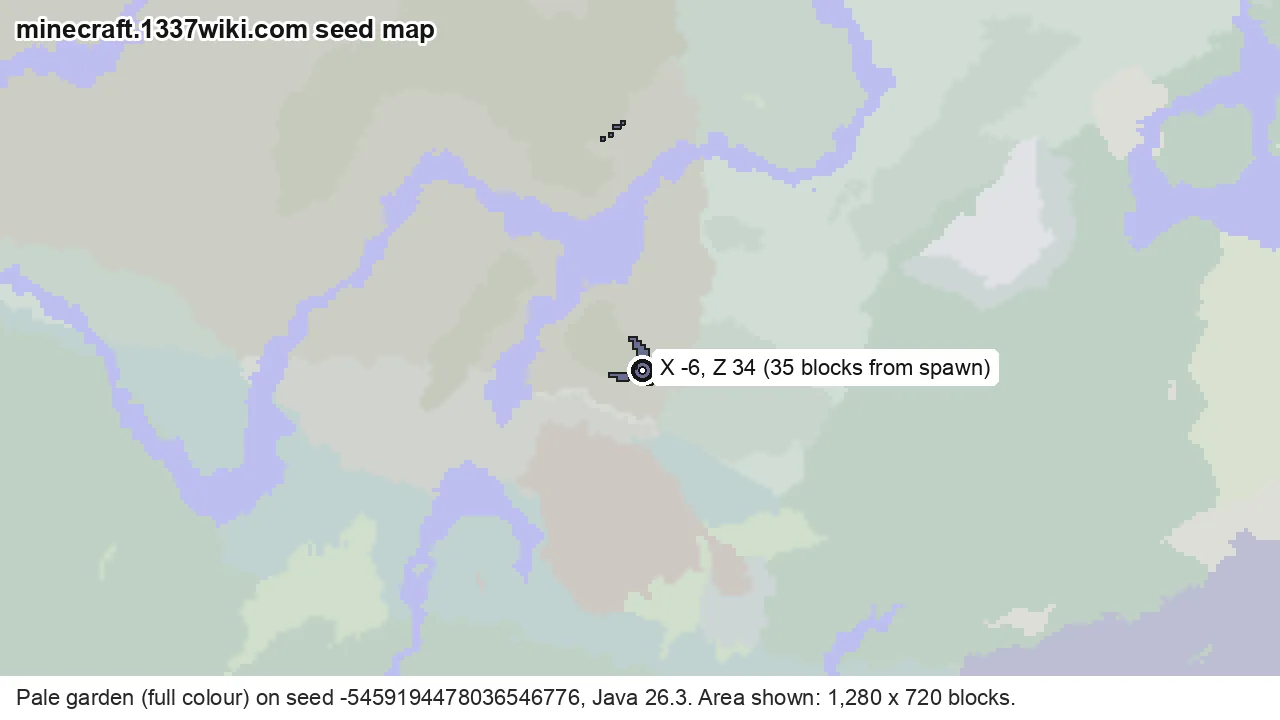
These three Java 26.3 seeds have a pale garden close to spawn. Each coordinate is inside the pale garden, checked at block level.
| Seed | Pale garden at | From spawn | Map |
|---|---|---|---|
-5459194478036546776 |
X -6, Z 34 | 35 blocks | Open on the map |
2284249835534816152 |
X -78, Z 174 | 134 blocks | Open on the map |
-7425750772181207496 |
X -50, Z 194 | 200 blocks | Open on the map |
In your own world, /locate biome minecraft:pale_garden finds the nearest pale garden (cheats on), or paste your seed into the biome finder. These are Java seeds; the same number on Bedrock gives a different world.
What changed since it was added
In Spring to Life (Java 1.21.5, March 2025), creakings became nameable with name tags: a named creaking stays through the day, though its heart still removes it if it gets stuck in a player or strays too far, and it is still immune to damage. The same update gave dormant hearts their daytime texture. In Chase the Skies (1.21.6), placing a heart correctly between two pale oak logs became the “Heart Transplanter” advancement. Source: the official 1.21.4, 1.21.5 and 1.21.6 release notes.
How we measured
The pale garden numbers come from our own seed map engine, running Java Edition 26.3 world generation: 300 random seeds, sampling every 16th block across a 10,240 by 10,240 block square centered on each world’s spawn. The seeds above were picked from the same run, and each coordinate was re-checked at block level. Everything about how the creaking behaves comes from the official release notes linked above.