What a geode is
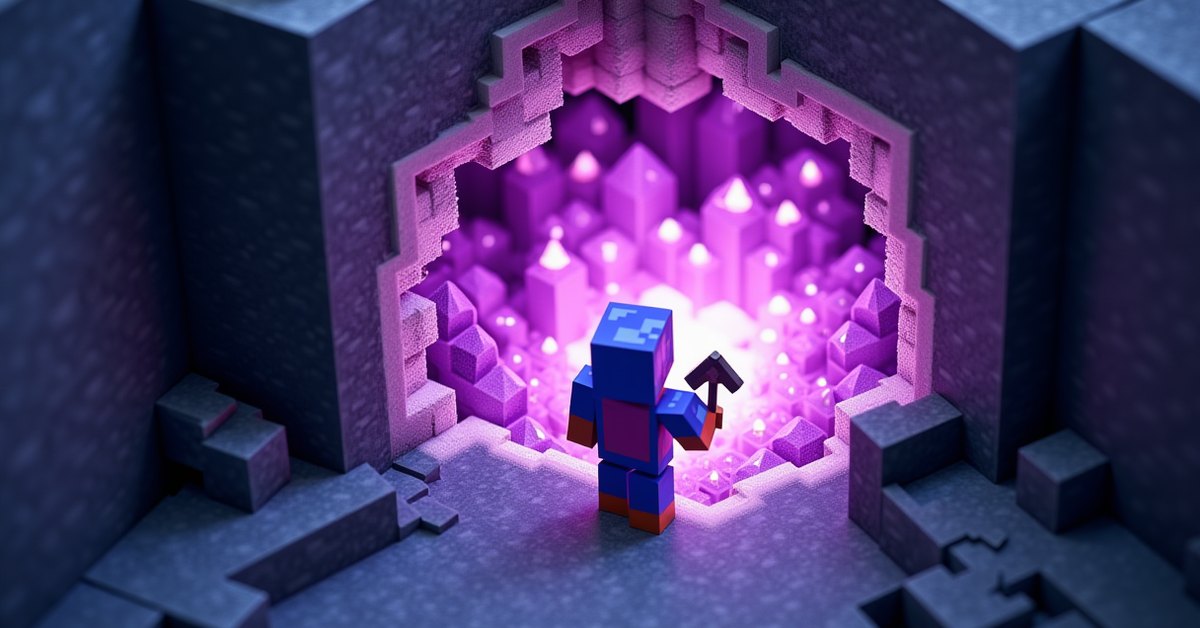
A geode is a hollow, ball-shaped structure that generates underground in the Overworld. Crack one open and you find the game’s only natural source of amethyst: purple crystals growing out of the walls, ringed by two stone layers that make the whole thing easy to recognize once you know the look.
Geodes arrived in the 1.17 update and haven’t changed much since. They matter because amethyst is the only way to craft a spyglass, tinted glass, and the amethyst blocks that chime when you walk on them. If you want any of those, you need to find a geode first.
This guide covers where geodes spawn, how to mine the crystals without wasting them, and how to set up a farm so you never run out of shards.
The three layers of a geode
Every geode has the same build, from the outside in:
- An outer shell of smooth basalt, the dark gray rock that seals the geode off from the surrounding stone.
- A middle layer of calcite, a bright white block that crumbles fast and marks the halfway point.
- An inner wall of amethyst blocks and budding amethyst, with amethyst clusters growing off the budding blocks into the hollow center.
The empty space in the middle is where the crystals grow. Small geodes are cramped; large ones can be big enough to stand up in. When you hit a pocket of pure white calcite while mining, you are usually one layer away from the amethyst.
Where geodes spawn
Geodes generate almost anywhere below sea level in the Overworld, from around Y 30 down to the bottom of the world near Y -58. They skip the deepest slice of the map, so digging to bedrock is not the goal. Mid-depth caves and tunnels around Y -10 to Y 10 are a reliable band.
They spawn in every Overworld biome, including under oceans. A geode that generates inside a large cave can be partly exposed, and one under the ocean floor sometimes breaks the surface, leaving amethyst poking out of the seabed. Those exposed geodes are the easiest to spot because the white calcite stands out against normal stone.
Two shortcuts help you find one faster. First, listen. Amethyst blocks give off a soft chime, so a geode nearby often announces itself with sound before you see it. Second, strip-mine or cave-dive at those mid-Y levels and watch for calcite. White blocks underground almost always mean a geode is right behind them.
If you play with cheats or a custom world, exposed geodes near the surface of a warm or deep ocean are the quickest to reach, since you can dive straight down instead of digging through hundreds of blocks of stone. In a normal survival world, though, most of your finds come from ordinary caving, so treat every patch of white calcite as a reason to stop and dig.
How to mine amethyst
The crystals come in two forms, and they behave differently when you break them.
Amethyst clusters
A cluster is the fully grown crystal that sticks out of budding amethyst. Break it with any pickaxe and it drops 4 amethyst shards. Use a pickaxe with Fortune and you get more shards per cluster, up to 8 with Fortune III. If you want the cluster block itself for decoration, mine it with Silk Touch instead, which drops the intact cluster rather than shards.
Breaking a cluster with your fist or the wrong tool still destroys it but drops nothing, so always bring a pickaxe.
Amethyst buds
Before a crystal becomes a full cluster it passes through three smaller stages: small bud, medium bud, and large bud. These earlier stages drop nothing at all, even with Silk Touch, unless you are willing to lose them. Leave the buds alone and let them grow into clusters, which is where the shards actually come from.
Budding amethyst is a trap
The budding amethyst blocks are what grow the crystals, and it is tempting to want to take them home. You can’t. Budding amethyst drops nothing when mined, Silk Touch or not, and it can’t be pushed by pistons. It stays in the geode forever. Plan your farm around the geode where it sits rather than trying to relocate the blocks.
How crystals regrow
This is the mechanic that makes amethyst renewable. A budding amethyst block will grow a new bud on any of its faces that touches air or water. Over time that bud ticks up through the three stages and becomes a harvestable cluster. Break the cluster, wait, and the same face grows a new one.
Growth is slow and random, driven by random block ticks, so a single budding block trickles out crystals rather than flooding you with them. The more budding amethyst faces you expose, the faster your overall yield. That is the whole idea behind a farm.
Building a simple amethyst farm
Because you can’t move budding amethyst, the farm goes wherever the geode is. A basic manual setup works like this:
- Clear the calcite and any loose blocks around the budding amethyst so each block has open faces for buds to grow.
- Light the area or wall it off so mobs don’t spawn inside your farm.
- Come back on a timer and harvest every full cluster with a Fortune pickaxe.
Players who want a hands-off version build flying-machine or piston-based harvesters that sweep past the clusters and break them automatically, dropping shards into a hopper and water-stream collection system. Those are more work to wire up, but the payoff is a steady shard supply with no manual mining. For most survival worlds, a lit-up geode you visit now and then is plenty.
Tips and common mistakes
A few habits save you time and lost crystals at a geode.
- Don’t punch the crystals. Breaking a cluster without a pickaxe destroys it and drops nothing, so keep a pickaxe on your hotbar before you start.
- Don’t waste Silk Touch on shards. You only need Silk Touch if you want the cluster as a decoration block. For farming shards, a plain Fortune pickaxe gives the best yield.
- Leave the small and medium buds. They drop nothing when broken, so harvesting early just resets your farm for no reward. Only take full clusters.
- Light the geode. An open geode is a dark cavity where mobs spawn, and a creeper going off inside can blow holes in your budding amethyst. Torches or other light around the farm keep it safe.
- Mark the location. Geodes are easy to lose track of underground. Drop a marker, note the coordinates, or run a tunnel back to your base so you can return for each harvest.
What amethyst is used for
Shards are the payoff, and they go into a short list of items:
- Spyglass: two copper ingots and one amethyst shard. It zooms your view like a telescope.
- Tinted glass: one glass block surrounded by four shards. It blocks light while staying see-through, which is useful for dark rooms and mob spawners.
- Amethyst block: four shards in a square. It makes the chime sound when stepped on and can be crafted back into decoration.
The two stone layers have uses too. Calcite is a clean white building block, and smooth basalt works as a dark accent. Since a geode hands you all three materials at once, it is worth stripping the calcite and smooth basalt shell while you are there rather than leaving it.
Java and Bedrock differences
Geodes work almost identically on both versions. The structure, the layers, and the growth mechanic are the same. The main practical difference is in farm design: piston and flying-machine timing behaves slightly differently between Java and Bedrock, so a farm tutorial built for one edition won’t always drop straight into the other. The crystals themselves, the shard drops, and the Fortune bonus match up.
Frequently asked questions
How rare are amethyst geodes?
They are fairly common. Spend some time exploring caves below sea level and you will run into one without trying hard. Exposed geodes under oceans and in large caverns turn up especially often.
Can you move budding amethyst?
No. It drops nothing when mined, and pistons can’t push it. The blocks stay in the geode permanently, which is why farms are built on-site.
What is the best Y level to find geodes?
Anywhere from about Y 30 down to Y -58 works, but the mid-range around Y -10 to Y 10 is a solid place to search while you are already caving or mining.
Do amethyst clusters grow back?
Yes. As long as the budding amethyst block underneath survives, it keeps growing new buds on exposed faces, and those mature into clusters you can harvest again.
What pickaxe do I need for amethyst?
Any pickaxe breaks clusters and drops shards. Fortune increases the shard count, and Silk Touch lets you collect the intact cluster block instead of shards.
Why does my base make a chime sound near a geode?
Amethyst blocks and clusters produce a resonant chime when you walk on or break them. If you hear it underground, a geode is close by.
The bottom line
A geode is a one-stop shop for amethyst, calcite, and smooth basalt, and the crystals inside refill on their own. Find one, light it up, and treat it as a renewable mine you can tap whenever you need shards for a spyglass or a stack of tinted glass.