What trial chambers are
Trial chambers are large underground dungeons built from copper and tuff. They were added in version 1.21, the Tricky Trials update, and they are the first structure in the game designed as a combat challenge that adjusts to how many players walk into it. Every fight room is driven by a trial spawner, a block that releases a set number of mobs, waits for you to kill them, then pays out rewards and shuts down for a while.
The reward loop is what makes the structure worth the trip. Clearing spawners gives you trial keys, trial keys open vaults, and vaults hold the good stuff: enchanted books, diamonds, tridents, and armor trims. Run the harder ominous version and you can pull a heavy core, the one ingredient for the mace that you cannot get anywhere else.
This guide covers where the chambers generate, how the spawner math works, which mobs you will face, and how to flip a chamber into an ominous trial on purpose.
Where trial chambers generate
Trial chambers only generate in the Overworld, and only underground. They sit deep, in the deepslate layers, usually somewhere between Y=-40 and Y=-20. They do not care which biome is above them, so you can find one under a plains village just as easily as under a jungle. There is no surface marker; the first sign you are near one is usually a wall of tuff bricks or a copper grate showing up in a cave or a mineshaft.
There are three practical ways to locate one.
- Buy a trial explorer map from a cartographer villager. Once the cartographer has leveled up past novice, the map appears in its trade list and points to the nearest trial chambers the same way a woodland explorer map points to a mansion.
- Run
/locate structure minecraft:trial_chambersif cheats are enabled. This prints coordinates you can teleport to or dig toward. - Explore deep caves and mineshafts. Chambers are common enough that a long caving trip at deepslate level will often cut through one by accident.
The trial explorer map is the honest way to do it in survival. Bring emeralds and a compass, and expect the chamber to be a few hundred blocks away rather than right under the village.
Layout and block palette
A trial chamber is a sprawling box of rooms connected by corridors, stairs, and ladders. Most chambers are built around a central hall with several arms branching off it, and each arm ends in one or more fight rooms. Between the fight rooms you will find supply closets with chests, decorated pots that break for small loot, and a few dead ends that exist only to hide a vault.
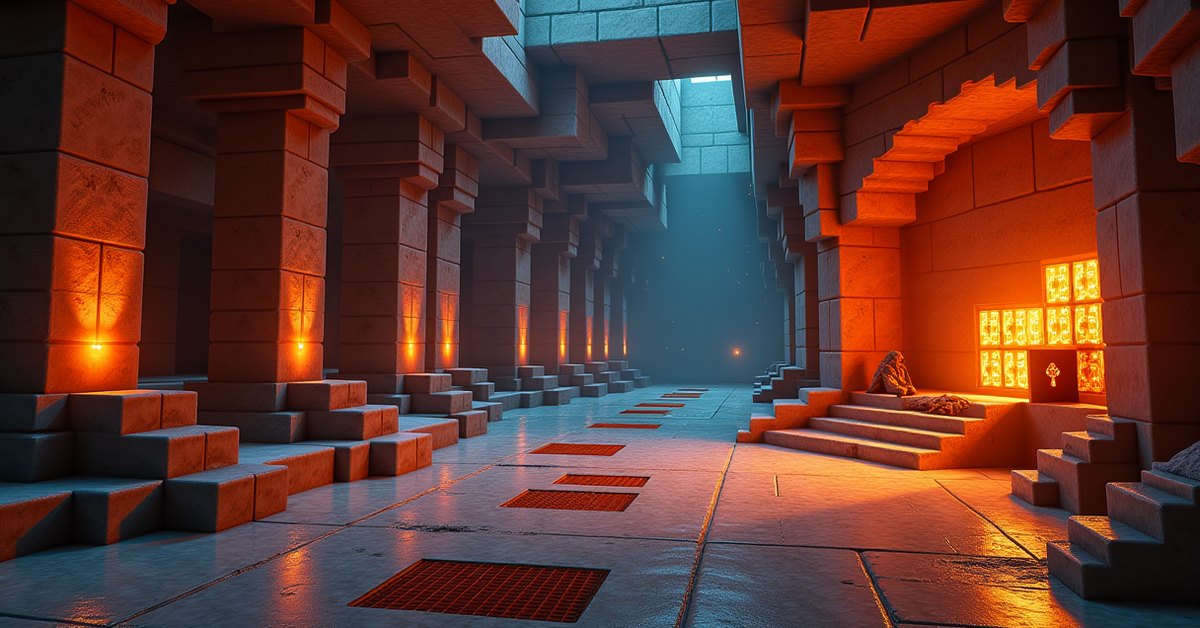
The palette is the easiest way to recognize one. The walls and floors are tuff in all its forms: plain tuff, polished tuff, tuff bricks, and chiseled tuff. Copper provides the accents, and it shows up in every oxidation state, from bright orange copper blocks to green oxidized ones, plus chiseled copper, copper grates, copper doors, and copper trapdoors. Lighting comes from copper bulbs, which is why chamber corridors have that dim orange glow instead of torchlight.
All of that copper is worth mining if you like the block set for builds. The oxidized copper in particular saves you a lot of waiting compared to weathering it yourself.
Fight rooms come in a handful of shapes. Some are open arenas where the spawner sits on a pedestal in the middle. Others are cramped, with the spawner tucked into an alcove or raised on a platform behind trapdoors. A few rooms hold two or three spawners and expect you to handle overlapping waves.
How trial spawners work
A trial spawner sits dormant until a player comes within 14 blocks. Once it detects someone, it starts spawning its assigned mob type in short bursts and keeps going until it has released its full quota. Kill every mob in that quota and the spawner ejects reward items, then goes into a 30-minute cooldown. During cooldown it does nothing, no matter how many players stand next to it. After the cooldown it resets and can be fought again, so a chamber is a renewable source of loot rather than a one-and-done dungeon.
The quota scales with the number of players in range. The defaults look like this:
| Setting | One player | Each extra player |
|---|---|---|
| Total mobs to kill | 6 | +2 |
| Mobs alive at once | 2 | +1 |
So a solo player fights six mobs, two at a time. A group of four fights twelve, with up to five alive at any moment. The spawner only counts players inside its 14-block range, so a friend hanging back in the corridor does not raise the difficulty, but also does not get counted for rewards.
Each spawner is locked to one mob type, and the mob is shown spinning inside the block once you get close. That preview matters, because it tells you whether to pull out a bow, a shield, or a sword before the first mob drops.
Two more details trip people up. Mobs from a trial spawner do not despawn while the fight is going, so walking away and coming back later does not give you a clean room. And the spawner will not spawn anything at all until a player is in range, which means the corridors between rooms are safe places to stand and heal.
Mobs you will fight
Trial chambers introduced two new mobs, and both show up only inside chambers in survival.
Breeze
The breeze is the signature mob of the structure. It bounces around the room and fires wind charges that knock you back and shove you off ledges. Arrows do nothing to it, so bring a melee weapon and close the distance. Breezes drop breeze rods, which you need for the mace and for crafting wind charges of your own.
Bogged
The bogged is a mossy skeleton variant that shoots poison-tipped arrows. It has less health than a regular skeleton, so it goes down fast, but the poison stacks up if you take several hits in a row. A shield blocks the arrows and the poison with them.
Standard mobs
The rest of the spawner pool is made of mobs you already know: zombies, husks, skeletons, strays, spiders, cave spiders, slimes, silverfish, and baby zombies. Slime rooms are the slowest to clear because every big slime splits into smaller ones that all count toward the kill quota. Cave spider and silverfish rooms are the most annoying in tight spaces. Baby zombie rooms are the ones that catch experienced players off guard.
Trial keys and vaults
When you clear a spawner, it spits out its rewards on the floor. Emeralds and arrows are common. The item you actually want is the trial key, which drops from a decent share of clears. Keys do not open anything on the spawner itself; they exist to unlock vaults.
A vault is a heavy tuff-and-copper block with a keyhole on the front, usually placed in a small alcove somewhere near the fight rooms. Walk up to it with a trial key and right-click. The vault consumes the key, plays an animation, and ejects a batch of loot. Each vault can be opened once per player, forever. It will not open a second time for you, but every other player on the server still gets their own turn with their own key.
Regular vault loot leans toward gear and enchantments. Expect a mix of the following across a few openings:
- Enchanted books, including the new Breach enchantment for the mace
- Diamonds and emeralds
- Golden apples and, less often, enchanted golden apples
- Tridents, which are otherwise only available from drowned
- Iron horse armor
- The bolt armor trim and the guster banner pattern
Because every player gets their own opening, vaults are much more generous on a multiplayer server than a single-player world. A group of four walks away with four rolls per vault.
Ominous trials
The ominous version of a trial chamber is the same building with the difficulty and the rewards both turned up. It is also the only way to get a heavy core.
Getting Bad Omen on purpose
Ominous trials start with the Bad Omen effect. Since 1.21, killing a raid captain no longer gives you Bad Omen directly. Instead the captain drops an ominous bottle, and you get the effect only when you drink it. Ominous bottles come in several levels, and a higher level means a stronger trial. You can also find ominous bottles inside ominous vaults, so once a chamber is running you can keep it going.
Carry Bad Omen into a village and you trigger a raid. Carry it into a trial chamber instead and it converts into Trial Omen, a separate effect that lasts fifteen minutes per level of the bottle you drank.
Ominous trial spawners
While you have Trial Omen, any trial spawner that detects you becomes an ominous trial spawner. The block turns blue-lit and starts spawning tougher versions of the same mobs, often carrying enchanted gear and armor. It also drops ominous item spawners from above that shatter into lingering potions and tipped arrows, so the floor around you becomes hazardous even when the mobs are dead. An ominous spawner that you converted mid-cooldown resets and can be fought immediately, which is a nice shortcut if you already cleared the regular version.
Rewards from an ominous clear are better, and the spawner can drop an ominous trial key instead of the normal one. That key fits a different block.
Ominous vaults, the heavy core, and the mace
Ominous vaults look like regular vaults with a darker, blue-tinted frame, and they only accept ominous trial keys. Their loot table is where the top-tier items live: the heavy core, enchanted books for Wind Burst, Density, and Breach, the flow armor trim, the flow banner pattern, more ominous bottles, and enchanted diamond gear.
The heavy core is the reason most players run ominous trials. Combine one heavy core with one breeze rod in a crafting table and you get a mace, a weapon whose damage climbs with the distance you fall before hitting the target. Since breezes drop breeze rods in the same chamber, a single well-run ominous trial can hand you both halves of the recipe.
Tips for clearing a trial chamber
A few habits make a chamber run much smoother.
Fight in the doorway, not the room. Spawners only trigger within 14 blocks, so you can often stand in the entrance, pull mobs to you one at a time, and step back out of range if you need to heal. This works especially well for spider and bogged rooms.
Bring a shield and a melee weapon before anything else. Breezes ignore arrows, bogged arrows are blocked by a shield, and most of the standard mobs are melee fodder. A bow is useful for picking off strays and skeletons at range, but it should be the backup, not the main weapon.
Light the room after you clear it. Trial spawners do not need darkness to work, but other hostile mobs can still spawn in the unlit corners of the chamber between waves. A stack of torches keeps the corridors clean while you wait out cooldowns.
Watch the water. Some rooms have dispensers and water traps that trigger when you step on pressure plates or open trapdoors. Sneak through unfamiliar rooms and look at the floor before you rush in.
Bring a bucket of milk for ominous runs. The lingering potions from ominous item spawners include poison, weakness, and slowness, and milk clears all of them at once.
Break the decorated pots. They are scattered through corridors and closets and often contain arrows, emeralds, or food. Hit them with your hand or a sword and pick up whatever falls out.
Mark your path. Chambers are big and symmetrical, and it is easy to lose track of which arm you have cleared. A trail of torches or a specific block placed at each junction saves a lot of backtracking when the cooldowns end.
Frequently asked questions
How deep are trial chambers?
They generate in the deepslate layers, usually between Y=-40 and Y=-20. If you are digging down from a trial explorer map marker, aim for around Y=-30 and then look for tuff bricks.
Can you get a trial explorer map from any cartographer?
Any cartographer can sell one once it levels up past novice. If a cartographer’s trade list does not show the map yet, keep trading paper and maps with it until it unlocks the next tier.
Do trial spawners reset?
Yes. After you clear one it goes into a 30-minute cooldown, then resets fully. You can fight the same spawner as many times as you want, and each clear rolls new rewards.
Can you break a trial spawner or a vault?
Both blocks are unbreakable in survival, and they cannot be pushed by pistons. In creative mode you can remove them, but you cannot pick up a working trial spawner as an item.
Can you open a vault twice?
Not with the same player. A vault remembers everyone who has opened it and will not open again for them. Other players who have not used that vault can still open it with their own key.
Where does the heavy core come from?
Only from ominous vaults, which you open with an ominous trial key earned from an ominous trial spawner. There is no way to craft or trade for a heavy core.
Do trial chambers exist on Bedrock Edition?
Yes. Trial chambers, trial spawners, vaults, the breeze, the bogged, and the mace all arrived on both Java and Bedrock in the 1.21 update, and the core mechanics work the same on both.
Worth the trip
The best way to think about a trial chamber is as a farm rather than a dungeon. The spawners reset every half hour, vaults open once per player, and the ominous loop feeds itself with ominous bottles. Find one near your base, clear it once to learn the layout, and it becomes the most reliable source of enchanted books and diamonds in the game.