Updated for Java Edition 26.3 (October 2026).
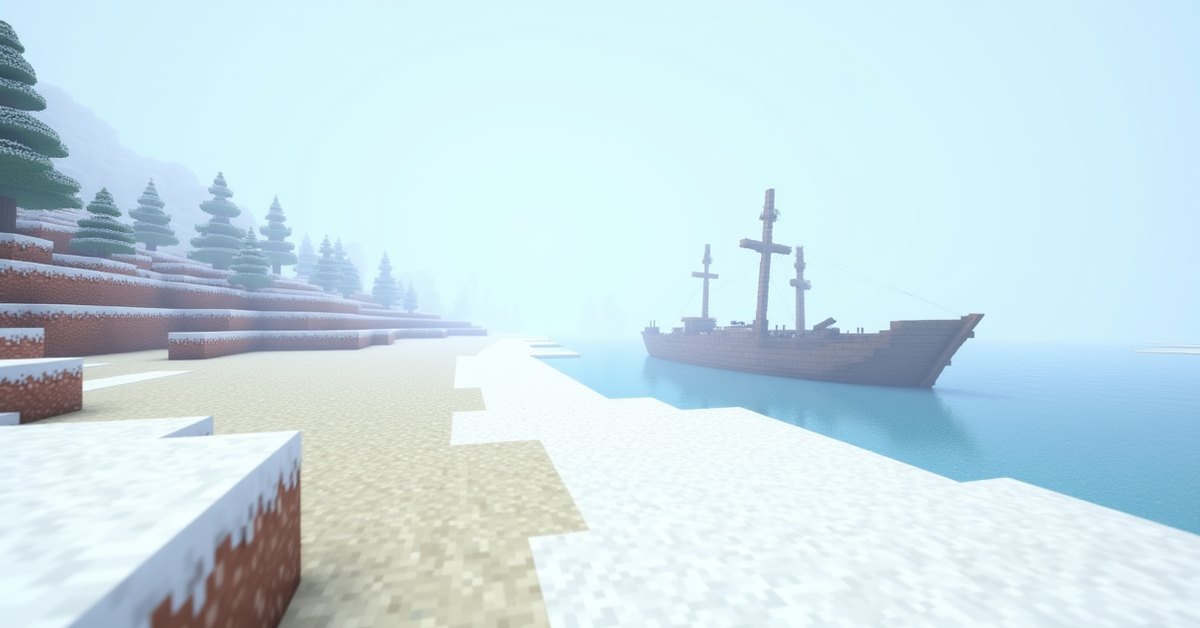
A snowy beach is the cold version of a beach: a strip of sand under a layer of snow where snowy land meets frozen or cold water. It snows here instead of raining, no animals spawn, and turtles never show up. In our sample of 300 Java 26.3 seeds it covered 0.33% of the surface. Come for buried treasure and beached shipwrecks.
| Dimension | Overworld |
|---|---|
| Where it generates | Along cold coasts, usually between frozen oceans or rivers and snowy plains or snowy taiga |
| How common | 0.33% of the surface in our sample (about 1 block in 300) |
| Distance from spawn | Median 1,846 blocks; within 1,000 blocks in 27% of seeds, within 2,000 in 54% (our sample) |
| Mobs | No animals; the usual hostile mobs at night |
| Notable blocks | Sand with snow layers on top, sugar cane by the water |
| Structures | Buried treasure, beached shipwrecks |
| Climate | Temperature 0.05 (snow, not rain) |
| Biome ID | minecraft:snowy_beach |
Snowy beach vs beach
| Feature | Snowy beach | Beach |
|---|---|---|
| Weather | Snow | Rain |
| Ground | Sand under snow layers | Bare sand |
| Animals | None | Turtles |
| Treasure | Same for both: buried treasure and beached shipwrecks | |
The structure rules treat both the same way: in the game’s data, buried treasure and beached shipwrecks generate in “beach” biomes, and the snowy beach counts as one. So a buried treasure map can just as easily lead you to a cold, snowy coast.
How to find a snowy beach
Head for snow near water. In our sample, a snowy beach’s edges touched a frozen ocean 31% of the time, a frozen river 21%, snowy plains 21% and snowy taiga 17%. Follow a frozen river out of snowy country to the sea and the shoreline will usually turn into one. They are not close to spawn in most worlds: the median distance was 1,846 blocks, though 96% of seeds had one within 5,000 blocks.
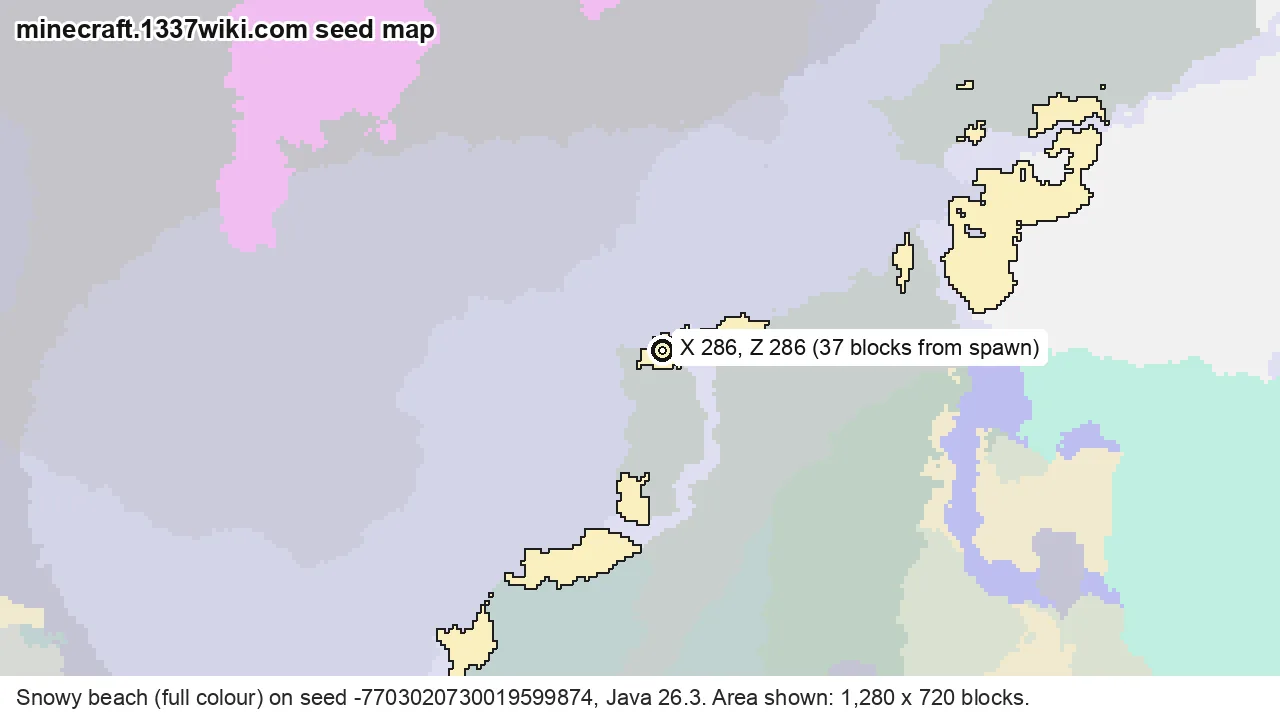
These three Java 26.3 seeds put a snowy beach right next to spawn. Each coordinate is inside the biome, checked at block level.
| Seed | Snowy beach at | From spawn | Map |
|---|---|---|---|
-7703020730019599874 |
X 286, Z 286 | 37 blocks | Open on the map |
-4815965004079874323 |
X 150, Z -122 | 28 blocks | Open on the map |
-975650178320086019 |
X -538, Z -254 | 31 blocks | Open on the map |
In your own world, /locate biome minecraft:snowy_beach finds the nearest one (cheats on), or paste your seed into the biome finder. These are Java seeds; the same number on Bedrock gives a different world.
What you find on a snowy beach
Mostly sand and snow. The snow layer sits on top of the sand, so dig through it to collect sand for glass. Sugar cane grows along the water’s edge, which makes a snowy beach a reasonable spot to start a paper farm if you settled in cold country.
Nothing peaceful spawns here: the game data gives the snowy beach no animal spawns at all. Turtles spawn on the regular beach only, never on its snowy or stony versions. At night the usual hostile mobs spawn on the open sand.
The reason to come is treasure. Buried treasure chests and beached shipwrecks can both generate on snowy beaches, and the frozen ocean next door often hides wrecks and ruins too.
What changed in 2025-26
In Spring to Life (Java 1.21.5, March 2025), the snowy beach was listed as a cold biome for the new farm animal variants, so a pig, cow or chicken spawned here (with a spawn egg, for example) comes out as the cold variant; they don’t spawn here naturally. Nothing in the later drops changed it. Source: the official 1.21.5 release notes.
How we measured
The numbers on this page come from our own seed map engine, running Java Edition 26.3 world generation. We generated 300 random seeds and sampled every 16th block across a 10,240 by 10,240 block square centered on each world’s spawn. “How common” is the biome’s share of those samples; “distance from spawn” is how far the nearest sample of the biome was. The seeds above were picked from the same run, and each coordinate was re-checked at block level.