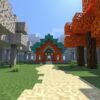
Updated for Java Edition 26.3 (October 2026).
A grove is a snowy forest of spruce trees on the lower slopes of the high, snow-capped mountains, added in Java Edition 1.18 (2021). It snows here instead of raining. In our sample of 300 Java 26.3 seeds it covered 0.53% of the surface, about as much as a meadow. Come for spruce wood, emeralds and the snowy wolf and fox variants.
| Dimension | Overworld |
|---|---|
| Where it generates | Lower mountain slopes, usually between snowy taiga or forest below and jagged or frozen peaks above |
| How common | 0.53% of the surface in our sample (about 1 block in 190) |
| Distance from spawn | Median 1,343 blocks; within 1,000 blocks in 35% of seeds, within 2,000 in 79% (our sample) |
| Mobs | Wolves, foxes and rabbits, plus the usual hostile mobs at night |
| Notable blocks | Snow, spruce trees, pumpkins; underground, emerald ore and infested stone |
| Structures | Pillager outposts, ruined portals; below ground, mineshafts and trial chambers |
| Climate | Temperature -0.2 (snow, not rain), downfall 0.8 |
| Biome ID | minecraft:grove |
| Added in | Java Edition 1.18 (Caves & Cliffs: Part II, 2021) |
Grove vs meadow
Both are mountain-slope biomes that sit below the peaks, and both are about equally common. They are easy to tell apart:
| Feature | Grove | Meadow |
|---|---|---|
| Climate | Snowy (temperature -0.2) | Mild (temperature 0.5) |
| Trees | A spruce forest | Almost none |
| Mobs | Wolves, foxes, rabbits | Sheep, rabbits, donkeys |
| How common (our sample) | 0.53% of the surface | 0.60% of the surface |
| Median distance from spawn (our sample) | 1,343 blocks | 786 blocks |
How to find a grove
Look for snowy mountains and climb. In our sample, a grove’s edges touched snowy taiga 21% of the time, forest 19%, jagged peaks 13%, frozen peaks 13% and taiga 9%. In practice that means the spruce forest you walk through on the way up from a snowy taiga toward the bare, icy summits.
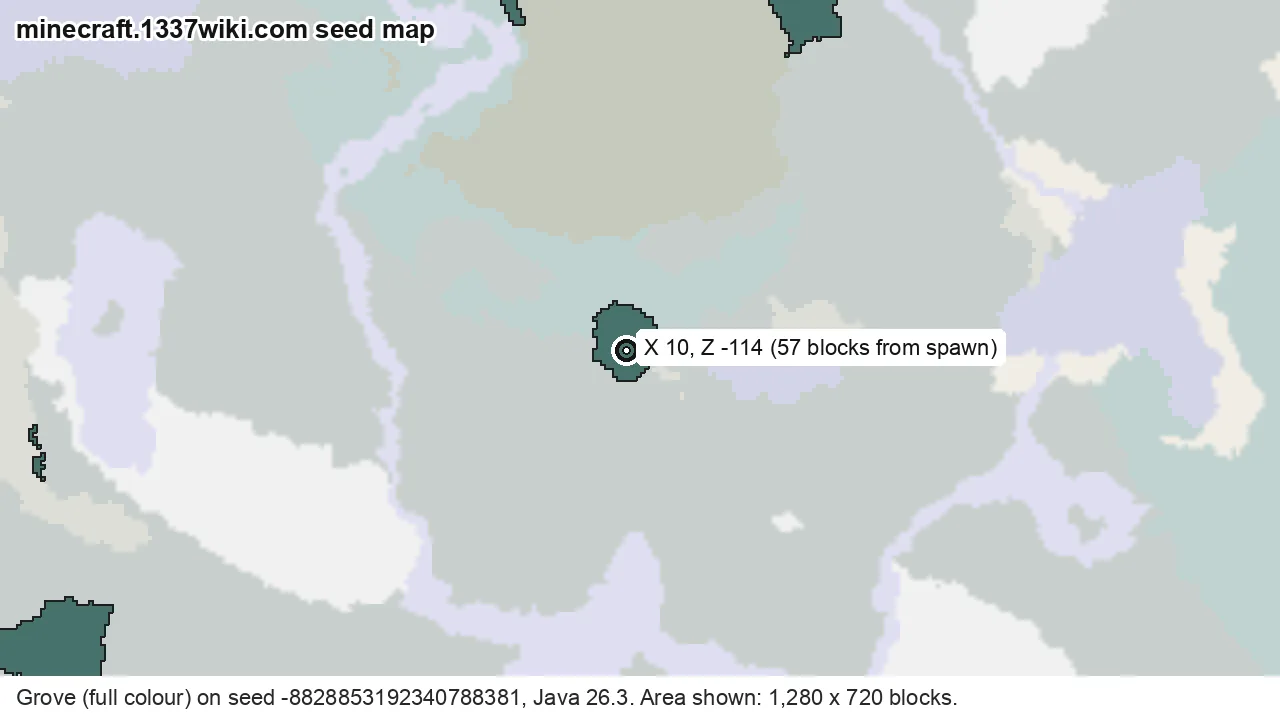
These three Java 26.3 seeds have a grove at or near spawn. Each coordinate is inside the grove, checked at block level.
| Seed | Grove at | From spawn | Map |
|---|---|---|---|
5268478892656762646 |
X 14, Z -18 | 23 blocks | Open on the map |
6526586548348208449 |
X -194, Z -106 | 221 blocks | Open on the map |
-8828853192340788381 |
X 10, Z -114 | 57 blocks | Open on the map |
In your own world, /locate biome minecraft:grove finds the nearest one (cheats on), or paste your seed into the biome finder. These are Java seeds; the same number on Bedrock gives a different world.
What you find in a grove
Mobs
Wolves, foxes and rabbits spawn here. Because the grove is a snowy biome, its wolves are the snowy variant and its foxes are the white snow foxes, so this is where to go if you want either. At night the usual hostile mobs spawn, and the snow and dense spruce make them hard to spot.
Blocks and resources
The slopes are covered in snow, with spruce trees for wood and the odd patch of pumpkins. Dig in and you will find emerald ore, which only generates in mountain biomes, and infested stone, which hides silverfish: if a stone block breaks faster than it should and a silverfish pops out, deal with it quickly: a hurt silverfish calls others out of nearby infested blocks.
Structures
Pillager outposts can generate on grove slopes, and ruined portals generate here as in most Overworld biomes. Underground, mineshafts and trial chambers can both be found beneath a grove.
What changed in 2025-26
In Spring to Life (Java 1.21.5, March 2025), the grove was listed as a cold biome for the new farm animal variants, so a pig, cow or chicken spawned here (with a spawn egg, for example) comes out as the cold variant; they don’t spawn here naturally. The same update added fallen trees to most forests but deliberately left them out of the grove. Nothing in the later 2025 and 2026 drops changed it. Source: the official 1.21.5 release notes.
How we measured
The numbers on this page come from our own seed map engine, running Java Edition 26.3 world generation. We generated 300 random seeds and sampled every 16th block across a 10,240 by 10,240 block square centered on each world’s spawn. “How common” is the biome’s share of those samples; “distance from spawn” is how far the nearest sample of the biome was. The seeds above were picked from the same run, and each coordinate was re-checked at block level.