What a torch is
The torch is the first light source almost every Minecraft player makes, and for most of a survival game it stays the one you reach for. One stick and one lump of coal turn into four torches, each one gives off light level 14, and you can stick them on floors and walls without any tools or fuel.
Light matters because hostile mobs only spawn in the dark. A torch is the cheapest way to make a patch of the world safe, whether that is your first dirt hut, a mine shaft, or the inside of a mob spawner room. Torches also melt snow and ice, mark the way out of a cave, and break falling gravel for you.
This article covers the recipe, the exact light rules, where a torch will and won’t attach, what water does to it, and how the plain torch compares to the soul torch and redstone torch.
How to craft a torch
Put a piece of coal in the crafting grid with a stick directly below it. The recipe works in your 2×2 inventory grid, so you do not need a crafting table. The output is 4 torches.
Charcoal works exactly the same way. You get charcoal by smelting any log in a furnace, which makes torches available on day one even if you have not found coal ore yet. If you have a stack of logs and no coal, burn one log as fuel to smelt the rest into charcoal, then craft the charcoal into torches. One log becomes one charcoal, and one charcoal becomes four torches.
A few other things to know about the recipe:
- Coal and charcoal are interchangeable in every torch recipe, including the soul torch.
- A block of coal does not craft into torches directly. Break it back into nine coal first.
- Torches stack to 64 and have no durability, so a single coal vein usually covers an entire mining trip.
Torches are also an ingredient. A torch surrounded by eight iron nuggets makes a lantern, and a carved pumpkin with a torch below it makes a jack o’lantern.
Light level 14 and mob spawning
A torch has a light level of 14, one below full sunlight at 15. Light drops by one for every block it travels, so the block next to a torch is lit to 13, the block after that to 12, and so on until the light runs out 13 blocks away. Light spreads in every direction, including up and down, but it does not pass through opaque blocks. Glass, leaves, fences, and other non-solid blocks let it through.
The current spawn rule
Since Java Edition 1.18, hostile mobs in the Overworld only spawn on blocks with a block light level of 0. Bedrock Edition made the same change in a later 1.18 update. Before that, mobs could spawn at light level 7 or lower, which is where the old advice to place torches every 12 blocks came from. That advice is out of date.
Under the current rule, any block that receives even light level 1 from a torch is safe. Because torch light reaches 13 blocks out, a single torch protects a much larger area than it used to. In a straight tunnel, a torch every 20 blocks leaves no gap at all. In an open room, a torch roughly every 12 to 14 blocks in each direction is more than enough. The thing to watch for is corners and pillars: light stops at opaque blocks, so a nook behind a wall can sit at light 0 even when the room next to it is bright.
Note that the rule is about block light, meaning light from torches, lava, glowstone, and similar sources. Sunlight is tracked separately. Mobs still spawn at night on the surface even though the sky light is high, because the block light there is 0. Put a torch down and that spot stays safe around the clock.
Checking light level
On Java, press F3 and look for the “Client Light” line, which shows the sky light and block light at the block you are standing on. Block light is the number that matters for spawning. Bedrock has no built-in light readout, so the practical approach is to place torches generously and trust the 13-block reach.
Placement rules
A torch needs something to hold it up. You can place one:
- on top of any block with a solid, full top face (stone, dirt, planks, glass, and most other full blocks)
- on top of a fence post, wall, top slab, or upside-down stairs
- on the side of any full solid block, where it becomes a wall torch
You cannot place a torch on the underside of a block. There is no ceiling torch, which is one reason lanterns exist. You also cannot place one on the side of a fence, a slab’s side, or on most non-solid blocks like chests and glass panes.
The torch is a non-solid block. Players, mobs, and items pass straight through it, and you can walk over a floor torch without noticing. It has no blast resistance, so any explosion nearby removes it.
Support and breaking
If the block a torch is attached to is removed, the torch pops off as an item. A wall torch depends on the block behind it, and a floor torch depends on the block below it. Pistons that push the support block away have the same effect. This also means you can break a torch with anything, including an empty hand, and it always drops itself.
Torches placed on sand or gravel stay put until that block falls. Dig out the block under a torch on sand and the sand falls, taking the torch with it.
Torches and water
Torches cannot be placed underwater, and they cannot be waterlogged. If flowing water reaches a torch, the torch breaks and drops as an item. Still water will not break a torch that is already there, but you cannot place a new one inside a water source block either.
This comes up in two common situations. When you dig into an underground lake or an aquifer, water pours down the tunnel and sweeps up every torch in its path, so pick them up as you retreat or accept the loss. And when you build under the ocean, torches are only an option in air pockets you have drained. Lanterns and sea lanterns handle wet builds; torches do not.
Lava behaves the same way. Flowing lava that reaches a torch destroys it, though the torch item burns up instead of dropping.
What torches are used for
Lighting
The obvious use. Torches light bases, farms, roads, and mines. They are cheap enough to spam and quick enough to place while walking, which is why most players carry a stack at all times.
Melting snow and ice
Snow layers and ice melt when the block light at their position reaches 12 or higher. A torch gives 14 at its own block, 13 one block out, and 12 two blocks out, so a torch clears snow layers and ice within two blocks of itself. That makes torches a simple way to keep a path clear in a snowy biome or to turn a frozen lake back into water without a pickaxe. It also means a torch placed too close to an ice farm or a snow layer build will slowly wreck it.
Breaking falling blocks while mining
When gravel or sand falls onto a torch, the falling block breaks and drops as an item instead of landing. If you hit a gravel pocket in a tunnel, dig out the bottom block, place a torch in the gap, and every gravel block above it falls through and turns into an item. You collect the whole column without being buried, and the tunnel is instantly clear.
The same trick clears a sand column in a desert or the gravel under a river. It only works while the torch is there, so place it before you break the block above.
Marking cave paths
Caves branch and loop, and torches are the standard breadcrumb. A common system is to place torches only on the right-hand wall while heading in, so on the way out you follow the torches on your left. Another is to place a torch on the floor at every junction, pointing along the branch you took. Neither costs anything beyond coal, and both save a lot of wandering.
Disabling a mob spawner
A spawner only spawns zombies and skeletons on blocks at light level 0. Torches placed on and around the spawner block raise the light across its whole spawn area, which switches it off until you take them away. This is the safe way to claim a spawner room before you decide whether to build a farm around it.
Torch, soul torch, and redstone torch
Minecraft has three torch variants, and they are not interchangeable.
| Torch | Recipe | Yield | Light level | Main purpose |
|---|---|---|---|---|
| Torch | Stick + coal or charcoal | 4 | 14 | General lighting |
| Soul torch | Stick + coal or charcoal + soul sand or soul soil | 4 | 10 | Blue light, repels piglins |
| Redstone torch | Stick + redstone dust | 1 | 7 | Redstone power source |
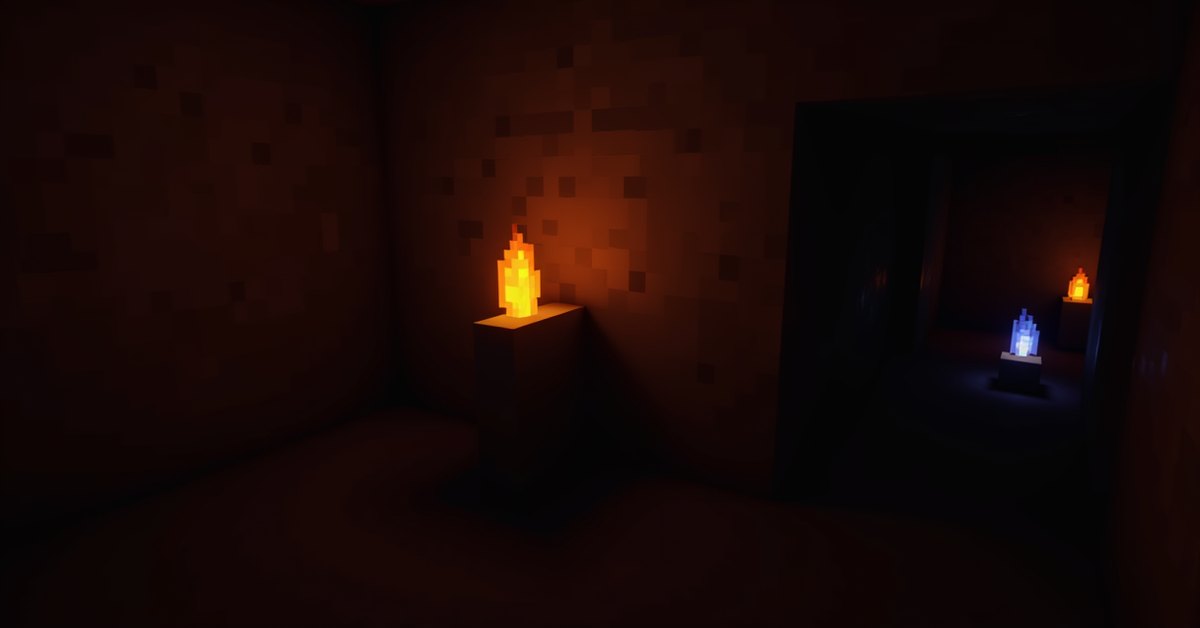
The soul torch burns with a blue flame and only reaches light level 10, so it lights a smaller area. Its point is that piglins avoid soul fire, which makes soul torches useful for fencing off a Nether base. Soul torches follow the same placement rules as regular torches and craft into a soul lantern with iron nuggets.
The redstone torch is a redstone component, not a light source you would build around. It gives off light level 7, enough to stop spawns within a few blocks but not enough to light a room, and it powers the block above it and any adjacent redstone dust. It turns off when the block it is attached to receives power, which is what makes it work as an inverter.
For comparison, glowstone, sea lanterns, and lanterns all emit light level 15, one higher than a torch. A campfire also emits 15. The torch’s advantage over all of them is cost: four torches per coal is hard to beat.
Java vs Bedrock differences
The recipe, the four-torch yield, light level 14, and the spawn rule are the same on both editions today. The differences are small:
- On Java, a floor torch and a wall torch are separate blocks internally,
minecraft:torchandminecraft:wall_torch. If you place torches with/setblock, usewall_torch[facing=north]and the other directions for wall placement. Bedrock uses a singletorchblock with a facing property. - Java’s
F3debug screen shows the exact block light at your position. Bedrock has no equivalent, so light-level checks on Bedrock come down to careful placement or a third-party tool. - The change to light-level-0 spawning landed in Java
1.18and in Bedrock a little later, so on an old Bedrock world that has not updated, the older light level 7 rule may still apply.
Tips and common mistakes
Keep a stack of torches in a hotbar slot you can reach without looking. Placing a torch while retreating from a creeper is a habit worth building, because the torch you drop behind you is the reason that tunnel is empty next time.
Do not rely on torches to light a spot you cannot see. Light stops at walls, so a torch in a hallway does nothing for the room behind the door. Stand in the dark corner and check whether you can actually see torch light reaching the floor.
Torches on the outside of a base do not stop mobs from walking in. They stop mobs from spawning on lit blocks, and nothing more. Mobs that spawn in the dark forest twenty blocks away will still wander over. Fences and doors handle that part.
When you are done with a spawner or a temporary mine, pick your torches back up. They are cheap, but a floor covered in torches makes redstone and building work a nuisance later.
Frequently asked questions
How many torches does one coal make?
One coal or one charcoal plus one stick makes four torches. A full stack of 64 coal is enough for 256 torches.
What light level is a torch?
A torch emits light level 14. The light drops by one per block, so it reaches 13 blocks away before fading to nothing.
Can you put a torch on the ceiling?
No. Torches attach to the top of a block or the side of a block, never the underside. Use a lantern if you want a light hanging from a ceiling.
Can torches be placed underwater?
No. Torches cannot be placed in water and cannot be waterlogged, and flowing water that reaches a torch breaks it. Use lanterns, sea lanterns, or glowstone for underwater lighting.
Do torches stop mobs from spawning?
Yes. Since the light-level-0 spawn rule, any block that gets light level 1 or more from a torch is safe from hostile spawns. A torch covers a 13-block radius in open space.
Do torches melt ice and snow?
Yes. Ice and snow layers melt at block light 12 or higher, so anything within two blocks of a torch melts. Keep torches at least three blocks away from ice or snow you want to keep.
Why did my torch disappear?
The most likely causes are water flowing into it, the block it was attached to being broken or pushed by a piston, or an explosion. A torch never burns out on its own.
The one trick worth remembering
Everyone uses torches for light. Fewer players use the gravel trick, and it is the one that saves the most time underground: dig the bottom block, drop in a torch, and let the whole column fall and turn into items. Once you have done it once you will never punch through gravel block by block again.