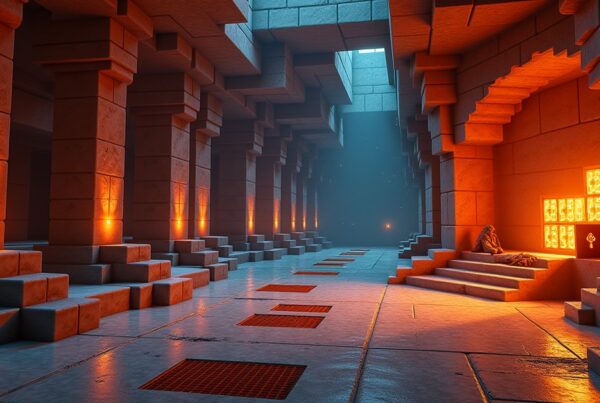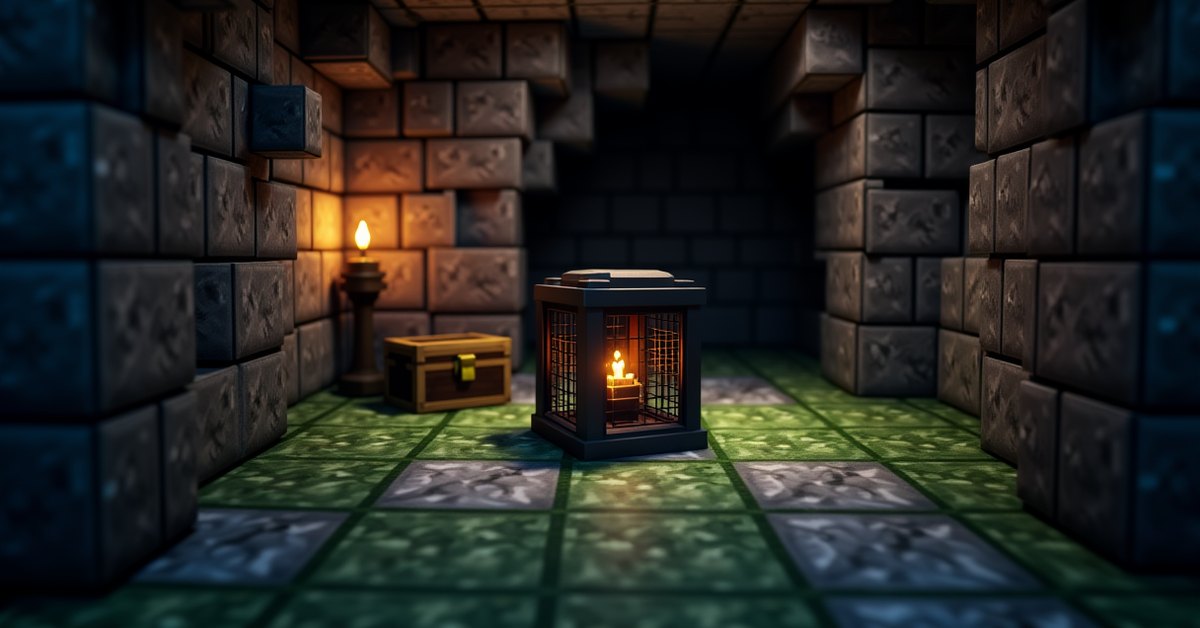
A dungeon in Minecraft, called a monster room in the game files, is a small underground room built from cobblestone and mossy cobblestone. In the middle sits a mob spawner that keeps producing zombies, skeletons, or spiders. Tucked against the walls you will usually find one or two chests with some of the better early-game loot in the Overworld.
Players hunt for these rooms for two reasons. The chests can hold saddles, name tags, enchanted books, and music discs you cannot get any other easy way. The spawner in the center is a ready-made engine for an experience farm, so a single dungeon can cover your enchanting needs for the rest of a world.
What is a dungeon?
A dungeon is a generated structure, which means the game places it into the world during terrain generation rather than the player building it. It appears only in the Overworld, and only underground. The room can sit a few blocks under the grass or hundreds of blocks down near bedrock. Because it carves out its own air pocket, a dungeon often breaks into nearby caves, ravines, or mineshafts, which is how most players stumble onto their first one.
The room itself is simple. The floor is a random mix of cobblestone and mossy cobblestone, the walls are cobblestone, and the interior is a flat open space one player can walk around in. Interior sizes vary between 5×5, 5×7, 7×5, and 7×7 blocks, with a ceiling that is usually the surrounding stone. The mossy cobblestone is the giveaway: it appears almost nowhere else naturally, so a patch of green-tinged cobble underground almost always means a dungeon is close.
The star of the room is the spawner block. It looks like a dark cage with a tiny spinning mob inside, and that miniature mob tells you what the spawner will produce.
How to find a dungeon
Dungeons do not show up on any map, so finding one comes down to exploring and paying attention. A few approaches work better than random digging.
The most reliable method is caving. Large cave systems, ravines, and abandoned mineshafts frequently cut through dungeons, exposing part of the cobblestone shell. When you are exploring caves, watch the walls for cobblestone or mossy cobblestone that you did not place. Natural stone does not generate as cobblestone, so any cobble underground was either placed by a player or is part of a dungeon.
Sound is the second clue. A spawner that has been sitting idle still holds the mobs it spawned, and you will often hear zombies groaning or skeletons rattling from behind a wall before you see anything. If you hear hostile mobs in a spot that looks sealed off, dig toward the noise.
If you would rather skip the hunt, you can build a tool to help. On Java Edition you can enable the debug screen and use third-party seed tools, and many players use the /locate style commands on other structures, though dungeons themselves are not listed in the standard /locate registry. For most survival players, caving with your ears open is the honest answer.
What the spawner does
The spawner is the reason a dungeon is worth keeping rather than mining out. It is a block that repeatedly spawns a set mob type as long as a player is nearby.
A spawner activates when a player comes within 16 blocks of it. Once active, it tries to spawn up to four mobs at a time in the area around it, then waits somewhere between 10 and 40 seconds before trying again. The mobs appear in the darkness around the spawner, so if the room is dark and open, they pile up fast. Step outside that 16-block radius and the spawner goes quiet until you return.
Spawning still follows the normal light rules. Zombies, skeletons, and spiders need a low light level to appear, so a fully lit room shuts the spawner down even while you stand next to it. This is the switch you use to control a dungeon: torches off means mobs, torches on means peace.
You cannot pick up a spawner. Mining it with any pickaxe breaks the block and drops nothing, though it does give a nice chunk of experience on the way out. There is no Silk Touch trick in vanilla survival that lets you move a spawner, so whatever mob your dungeon rolled is the mob you are stuck with.
Dungeon chest loot
Each dungeon generates with one or two chests, and the loot inside is what makes the trip worthwhile. The tables lean toward items that are annoying or impossible to get elsewhere early in a world.
The rare pulls are the draw. Dungeon chests are one of the few sources of the saddle before you reach a Nether fortress or start fishing seriously, and they are a common source of the name tag. They can also contain enchanted books, a golden apple, and on a lucky roll an enchanted golden apple.
Music discs are the collector’s prize. The discs “13” and “Cat” appear in dungeon chests and essentially nowhere else through normal play, aside from a creeper being killed by a skeleton. If you want those two tracks for your jukebox, a dungeon chest is the place to look.
The rest of the loot is bulk survival material: iron ingots, gold ingots, bread, wheat, string, gunpowder, redstone, coal, bones, and the occasional bucket or spider eye. None of it is exciting on its own, but it adds up when you are early in a world and short on iron.
Turning a dungeon into an experience farm
The most common use for a dungeon is a spawner-based mob farm that hands you a steady stream of experience and drops. The idea is to let the spawner keep producing mobs, then funnel them somewhere you can kill them safely.
The basic build looks like this. Light up the whole area except the spawner room itself so nothing spawns from the surrounding caves and competes with your spawner. Hollow out the space around the spawner to give mobs room to appear, then dig a channel that pushes them, usually with flowing water, into a one-block drop or a collection point. A fall of about 22 blocks leaves most mobs at half a heart, so a single hit finishes them and you collect the full experience and drops.
A few practical notes make the build smoother:
- Keep the spawner dark. A torch on or near it stops spawning entirely, which is useful while you build but must come off when you are done.
- Stay within 16 blocks of the spawner while farming, or it will stop producing mobs.
- Give mobs a 3-block-tall space to spawn in around the spawner, or spiders and other tall mobs may not appear.
- A skeleton spawner is the best of the three for a farm because it drops bones and arrows on top of experience.
Once it runs, a dungeon farm covers your levels for enchanting, anvil work, and repairs for as long as the world lasts.
Java and Bedrock differences
Dungeons behave almost the same across both editions. The room shape, the spawner, and the two-chest layout are consistent, and the spawner mechanics work the same way in each. The main variation is in the loot tables, which differ slightly between Java and Bedrock, so the exact odds on a saddle or a music disc are not identical version to version. The core outcome is the same: rare tack items, the “13” and “Cat” discs, and a pile of early-game supplies.
Frequently asked questions
Can you get a spawner from a dungeon?
Not as an item. Mining the spawner destroys it and drops nothing, though you do gain experience. In survival there is no vanilla way to pick up and relocate a spawner, so you have to build your farm where the dungeon generated.
How do you stop a dungeon spawner?
Light it up. Spawners still obey light levels, so placing torches on and around the spawner block raises the light enough to block hostile spawns. If you want it gone permanently, mine the spawner out with a pickaxe.
What mobs come from a dungeon spawner?
One of three: zombies, skeletons, or spiders. The type is fixed when the dungeon generates, and the little spinning mob inside the cage shows you which one you have.
How deep do dungeons spawn?
Anywhere underground in the Overworld, from just below the surface down to near bedrock. They generate wherever there is room, which is why they so often connect to caves and ravines.
Are dungeon chests worth it?
Yes, especially early. A saddle, a name tag, enchanted books, and the “13” and “Cat” music discs are hard to get any other way at the start of a world, and the bulk iron and gold help before you have a real mine going.
Why is there mossy cobblestone in a dungeon?
It generates as part of the floor. Dungeons are the main natural source of mossy cobblestone in the Overworld, which is why a patch of it underground is a strong sign that a dungeon is nearby.
Worth the dig
A dungeon rewards you twice: once from the chests, and then continuously from the spawner if you build around it. If you find one early, light the surrounding caves, leave the spawner dark, and turn it into the experience farm that carries the rest of your world.