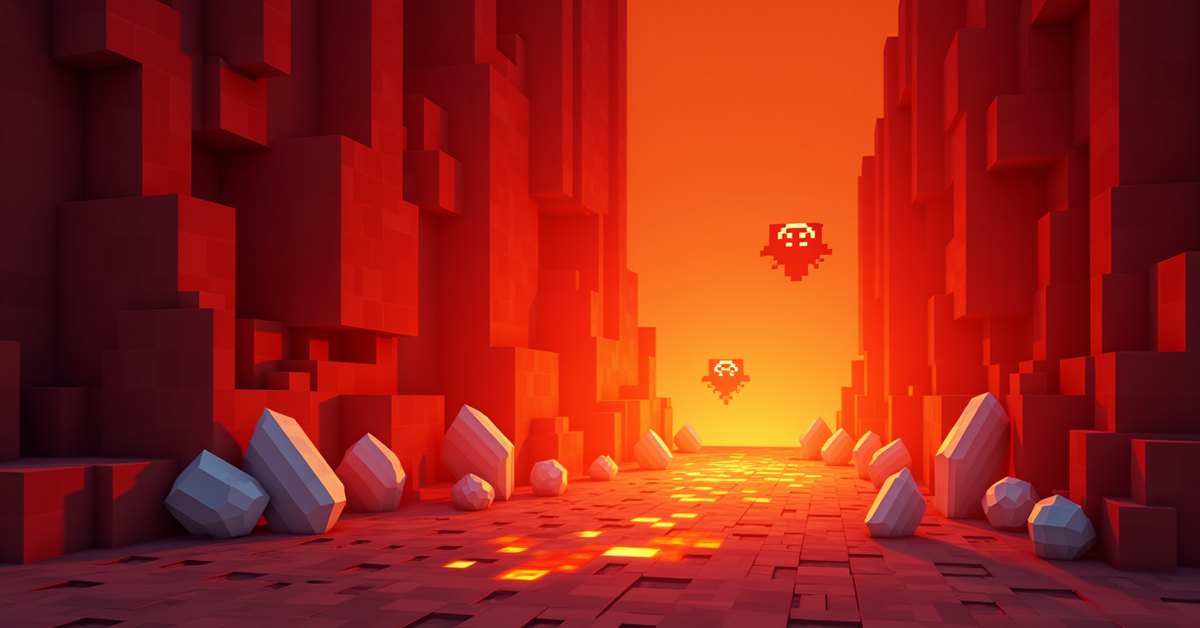
Nether quartz ore is the easiest way to get nether quartz, a resource you’ll need for almost every redstone build past the basic stage. It’s the white-flecked block scattered through the Nether’s netherrack, and it shows up often enough that you’ll usually leave the Nether with stacks of quartz without going out of your way to mine it.
Quartz powers the comparator, the daylight sensor, and the observer, all common parts of advanced redstone builds. It also turns into the cleanest white building block Minecraft has. Knowing where this ore spawns, how to mine it, and which enchantments help is worth a few minutes of reading before your next Nether trip.
What is nether quartz ore?
Nether quartz ore is a block that generates inside netherrack across the Nether dimension. Mining it drops one nether quartz, the raw item used in crafting. It’s visually distinctive: bright white crystal chunks set into the red-orange netherrack, so you can spot it at a glance from a fair distance away.
The ore was added in the 1.5 update (the Redstone Update) and has been the main source of quartz ever since. You won’t find it anywhere in the Overworld or The End under normal gameplay. If you need quartz, you go to the Nether.
Where nether quartz ore spawns
Quartz ore generates in veins of 4 to 10 blocks throughout the Nether. The ore can appear at almost any height in the dimension. In current Java versions it spawns from roughly Y=10 to Y=117, and Bedrock follows a similar range. In practice, you’ll see it from the bottom of the Nether all the way up to the ceiling.
A few notes on where to look:
- Near lava lakes, on cliff faces, and along open ravines, exposed quartz is everywhere. Easy and free.
- Inside thick netherrack walls, you’ll find more, but it takes mining to get at.
- Soul sand valleys, basalt deltas, and crimson and warped forests all contain quartz ore. Soul sand valleys and basalt deltas tend to have more exposed ore on their walls.
- The Overworld won’t have any. Don’t waste time searching there.
How to mine nether quartz ore
The basics are simple: hit it with a pickaxe and pick up the quartz that drops. The details are where the time savings live.
Pickaxes and mining speed
Any pickaxe tier can mine nether quartz ore, including a basic wooden one. The block will drop quartz with a wooden pickaxe; the mining speed scales with the tool:
- Wooden pickaxe: slowest
- Stone pickaxe: faster
- Iron pickaxe: noticeably quicker
- Gold pickaxe: very fast but breaks quickly
- Diamond pickaxe: fast and durable
- Netherite pickaxe: fastest, and the netherite armor knockback resistance matters more in the Nether than the small extra speed
If you’re farming quartz seriously, bring at least an iron pickaxe with Efficiency. Anything below that and you’ll spend more time mining than collecting.
Fortune and Silk Touch effects
Fortune dramatically increases quartz yield per ore:
- Fortune I: 1 to 2 quartz per ore
- Fortune II: 1 to 3 quartz per ore
- Fortune III: 1 to 4 quartz per ore
The drop is random within those ranges, but the average climbs steadily with each level. For a long quartz run, Fortune III is the single best upgrade you can bring.
Silk Touch does the opposite: it drops the ore block itself instead of the quartz item. That’s useful if you want to move ore back to a base for display, or if you want to smelt it later for the smelting XP, but it’s not what you want for raw quartz gathering. You can’t put Fortune and Silk Touch on the same pickaxe, so choose based on what you actually need.
Experience drop
Mining nether quartz ore without Silk Touch drops 2 to 5 experience per block. That matches the experience range of lapis lazuli and redstone ore in the Overworld. If you’re trying to level up for enchanting, a long quartz mining session is one of the faster ways to do it, especially with a Fortune III pickaxe pulling more raw resource per block on top of the XP.
What nether quartz is used for
Quartz works in two very different parts of the game. It’s used for decorative blocks and for redstone components, and most blocks only do one of those jobs.
Decorative quartz blocks
The basic crafting chain looks like this:
- 4 nether quartz arranged 2×2 makes 1 block of quartz
- Smelting a block of quartz gives a smooth quartz block
- 2 quartz slabs stacked makes a chiseled quartz block
- A quartz block can be cut into quartz slabs and quartz stairs with the standard slab and stairs recipes
- A quartz block can be crafted into a quartz pillar with vertical orientation
- 4 quartz blocks arranged 2×2 makes 4 quartz bricks (added in 1.16)
Quartz blocks are the cleanest white building block in Minecraft. They work for modern builds, clean interiors, and anywhere you want a bright neutral surface. Smooth quartz in particular has no seams and reads as solid white, which is hard to match with any other vanilla block.
Redstone components
Quartz also crafts three components a serious redstone build can’t easily do without:
- Redstone comparator: 3 stone + 3 redstone torches + 1 nether quartz. Reads container fullness, holds signal strength.
- Daylight sensor: 3 wood slabs + 3 glass + 3 nether quartz. Outputs a signal based on sky light level.
- Observer: 6 cobblestone + 2 redstone dust + 1 nether quartz. Detects block updates on the face it’s pointed at.
You won’t build farms, sorting systems, or any timer-based contraption without these. A few stacks of quartz lasts a long time, but the requirement adds up across a survival world.
Smelting and silk touch
If you mine ore with silk touch and bring the block back to a base, you can smelt it in a furnace or blast furnace for 1 nether quartz per ore plus 0.2 XP. That XP-per-block number is small, but if you batch hundreds of ores into a furnace bank, the XP total adds up.
Most players skip silk touch entirely. The default mining drop is already the quartz you want, and Fortune III gives more total quartz than silk touch plus smelting ever will. Silk touch is more about flexibility (moving ore to a display wall, deferring smelting for later XP) than about raw efficiency.
Java vs. Bedrock differences
The differences between editions are minor for this block. Both editions use the same crafting recipes, the same Fortune scaling, drop XP when the ore is mined, and generate quartz ore in netherrack across the dimension.
A few small notes that may matter for redstone-heavy players: the precise probability distribution of Fortune drops can differ slightly between versions, and the generation algorithm for quartz veins varies a bit, so what looks like an unusually rich or empty Nether biome on one platform may not be the same on the other. For most players the practical result is the same: bring a Fortune III pickaxe, mine for half an hour, leave with several stacks.
Tips for efficient quartz farming
A few habits that make a real difference on a long quartz run:
- Build a small base on a netherrack platform near an open lava lake. Open ceilings mean more exposed ore and less mining.
- Bring at least two pickaxes. Quartz mining chews through durability faster than you’d expect because you’re mining a lot of surrounding netherrack to reach the ore.
- Use a fire-resistance potion (8-minute splash or 3-minute drinkable) before going. Lava is the leading cause of death in a quartz session, not mobs.
- Sneak when mining on a ledge. A wandering ghast or a stray skeleton arrow can knock you off easily.
- Cover lava with netherrack as you go. The next return trip will be much safer once the obvious lava drops are filled in.
- Don’t bring iron armor. A blaze hit plus a single ghast fireball will end you faster than you can react. Diamond or netherite only.
A bartering setup with piglins works as a backup. Piglins can give nether quartz in exchange for gold ingots, and the drop rates are decent enough that an idle bartering farm builds up quartz over time. It’s not as fast as mining, but it’s safer.
Frequently asked questions
Can you find nether quartz ore in the Overworld?
No. Quartz ore only generates naturally in the Nether dimension. You can place it in the Overworld using creative mode or commands, but no world generation puts it there.
What pickaxe do you need for nether quartz ore?
Any tier works, including wooden. The block drops quartz with a wooden pickaxe. Faster pickaxes save time, but tier isn’t a gating requirement the way it is for diamond, gold, or iron ore.
Does Fortune work on nether quartz ore?
Yes, and it makes a big difference. Fortune III averages around 2 to 2.2 quartz per ore versus 1 per ore without the enchantment, more than doubling your effective yield.
Can you smelt nether quartz ore?
Yes, if you’ve collected the ore with silk touch. Smelting one ore in a furnace gives one nether quartz and 0.2 XP. Without silk touch the ore drops quartz directly, so smelting isn’t part of a normal mining loop.
What does nether quartz craft?
Quartz blocks (and their slabs, stairs, pillars, bricks, smooth and chiseled variants), redstone comparators, daylight sensors, and observers. It’s also part of the recipes for granite and diorite if you’re making your own.
Is nether quartz ore worth using silk touch on?
For most players, no. Mining without silk touch drops the quartz directly and combines with Fortune for the highest yield. Silk touch is useful if you want the ore block for display or to bank smelting XP for later.
How rare is nether quartz ore?
Common. It generates in veins across the Nether at almost any height, and exposed ore on cliff faces and ravine walls is easy to find without serious mining. An hour in any Nether biome usually gives several stacks for a Fortune III user.
The shortcut version: bring a netherite or diamond pickaxe with Efficiency IV and Fortune III, find an open lava lake or ravine in the Nether, and start mining the exposed ore on the cliff faces. You’ll be back with a few stacks of quartz in well under an hour, and you’ll have enough material for both the redstone gear and the decorative builds you have planned next.