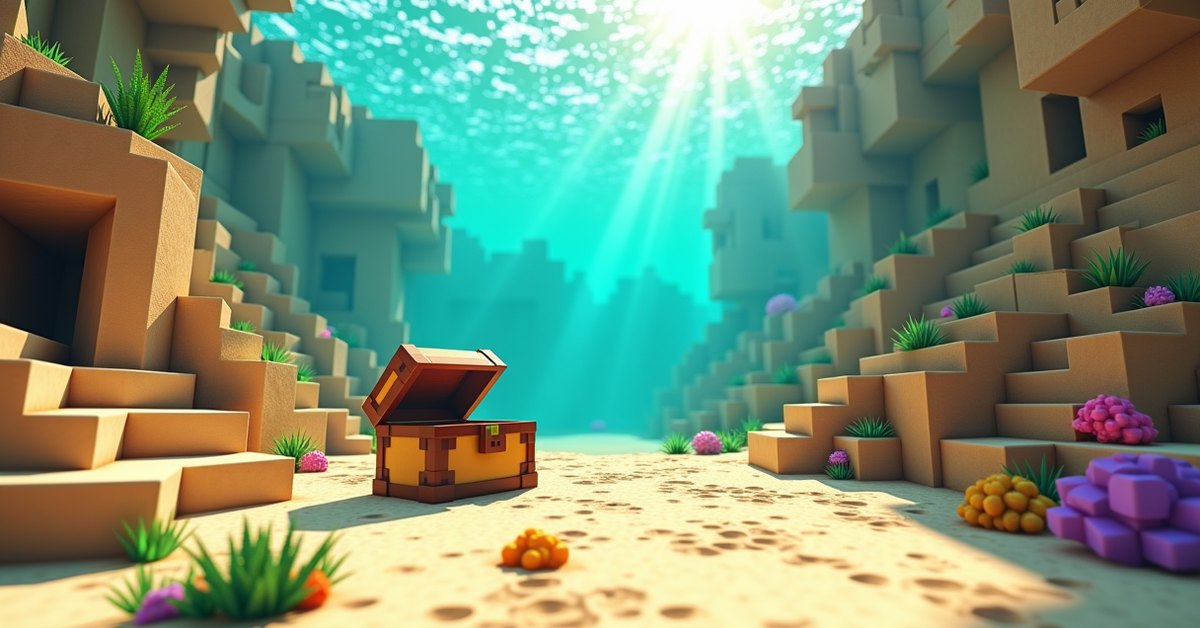
Warm ocean ruins are sunken sandstone structures that generate on the floor of warm and lukewarm oceans in Minecraft. They look like the crumbled remains of a desert village that slid under the waves, and they hold loot chests worth diving for.
The big draw is the buried treasure map. One of these ruins can point you straight to a chest holding a Heart of the Sea, the item you need to build a conduit. Along the way you get emeralds, enchanted books, and a fight with the drowned that patrol the wreckage.
This guide covers where warm ocean ruins spawn, how to spot them, what they are built from, and how to clear one without drowning halfway through.
What are warm ocean ruins?
Ocean ruins come in two flavors. The warm variant is made of sandstone blocks and generates in warm-water biomes. The cold variant is made of stone and generates in colder oceans. Everything below is about the warm, sandstone version.
Both types generate in two sizes. Small ruins are single broken buildings, often just a few blocks poking out of the sand. Big ruins are wider clusters that read like a drowned settlement, with several structures grouped together and more chests to find. A big ruin is the better target if you want loot, but small ruins are far more common, so you will clear plenty of those too.
The ruins were added in the Update Aquatic (version 1.13) and picked up suspicious sand in the Trails & Tales update (version 1.20), which turned them into a spot for archaeology as well as chest loot.
Where warm ocean ruins generate
Warm ocean ruins spawn on the seabed in three biomes: warm ocean, lukewarm ocean, and deep lukewarm ocean. Warm oceans are the ones with the bright turquoise water, coral reefs, and tropical fish, so if you see a reef you are in the right neighborhood.
They sit right on the ocean floor and are usually partly buried in sand and gravel. That burial is why they are easy to swim over without noticing. A small ruin might be a single sandstone wall and a scrap of floor, with the chest tucked under a layer of sand.
You will not find warm ocean ruins in cold, frozen, or regular (normal temperature) oceans. Those get the stone-built cold variant instead. If you are standing in blue-gray water with kelp and no coral, you are in cold-ruin territory.
How to find them
The fastest way to search is a boat and a clear day. Row across the surface of a warm ocean and look straight down. Sandstone reads as a warm tan color against the pale seabed, and the geometric shapes of walls and stairs stand out from the natural terrain.
Drowned are a useful tell. Warm ocean ruins spawn drowned as part of the structure, so if you see a cluster of them hanging around one patch of floor, there is often a ruin underneath. At night the drowned rise toward the surface, which makes them even easier to spot.
When you dive, a few enchantments make the trip bearable. Respiration on a helmet stretches how long you can hold your breath. Aqua Affinity stops the underwater mining penalty so you can dig sand off a chest at normal speed. Depth Strider on boots keeps you moving instead of crawling through the water. None of these are required, but clearing a ruin without them means a lot of surfacing for air.
A turtle shell helmet is a cheap alternative to Respiration. It gives ten extra seconds of breath on its own, which is often enough to grab a chest and kick back up.
What warm ocean ruins are made of
The warm variant is built almost entirely from the sandstone family: plain sandstone, cut sandstone, chiseled sandstone, and smooth sandstone, plus sandstone stairs and slabs for the broken edges. Sand and gravel fill in around the structure and bury parts of it.
Watch for magma blocks mixed into some ruins. A magma block creates a downward bubble column that pulls you toward the floor and deals damage if you sit on it. In open water that current can drag you down while your air runs out, so give any glowing block a wide berth or break it before you swim over it.
The sandstone itself is worth grabbing if you build. A ruin is a free stack of cut and chiseled sandstone that would otherwise cost you a trip to a desert and a crafting table.
Loot: chests, maps, and buried treasure
Each ruin generates with one or more loot chests, usually buried under sand so you have to dig them out. The chest contents lean toward early and mid game supplies: wheat, coal, gold nuggets, emeralds, leather armor, and the occasional enchanted book. A golden apple shows up now and then as the rare pull.
The item you actually want is the buried treasure map. Warm ocean ruins are one of the main sources of it, and the map marks a nearby buried treasure chest with a big red X. That treasure chest is the only renewable way to get a Heart of the Sea, which sits at the center of a conduit recipe. If you are chasing a conduit for underwater bases, ocean ruins are step one.
When you get a map, hold it and swim or sail toward the marker. The white dot on the map is you; line it up with the X. The treasure is buried under sand, gravel, or even stone on a nearby beach or seabed, so bring a shovel and dig down once you are on the mark.
Brushing suspicious sand
Since version 1.20, warm ocean ruins generate with suspicious sand blocks. These look almost like normal sand with a faint pattern. Equip a brush and hold right-click on one to slowly reveal what is inside. The block gives up a single item and then turns to regular sand.
Suspicious sand in ocean ruins can yield pottery sherds along with ordinary loot like emeralds, wheat, and coal. The sherds are decorative and go into decorated pots. Brush gently and do not break the block by hand, because mining it the normal way destroys whatever was inside.
The drowned and other dangers
The biggest threat at a ruin is the drowned. These underwater zombies deal solid damage, and some carry a trident they will throw at you from range. A ranged drowned can chip you down while you are busy digging out a chest, so clear the area before you commit to mining.
A few drowned carry a nautilus shell, and killing them is one way to farm shells for a conduit frame. So the same ruin can hand you both halves of a conduit project: the Heart of the Sea by way of the treasure map, and nautilus shells off the mobs guarding it.
The other danger is simpler: air. It is easy to get greedy, dig one more block, and realize you are too deep to reach the surface in time. Place a door, a conduit, or a column of sand to make an air pocket if you plan to work a big ruin for a while, or just keep a turtle helmet on and surface early.
Tips and common mistakes
Bring a shovel. Most of the loot in a ruin is buried, and digging sand with your fist underwater is painfully slow. A shovel with Aqua Affinity on your helmet turns a two minute dig into a few seconds.
Carry torches or another light source for after the dive. Warm ocean ruins are dark down on the floor, and once you surface you may want to mark the spot so you can find it again.
Do not tunnel straight down from a boat without checking for magma blocks first. Getting caught in a downward bubble column with low air is one of the most common ways players die at a ruin.
If you find a small ruin with one chest, look around before you leave. Small ruins often generate in loose groups, so a second or third structure with another chest is frequently a short swim away.
Java and Bedrock differences
The structure looks and generates the same on both editions, and both give you buried treasure maps from ruin chests. The loot tables differ slightly in the exact odds and item amounts, so do not be surprised if a chest on Bedrock feels a little richer or leaner than one on Java. The core plan is identical on both: find the ruin, dig out the chest, follow the map to buried treasure.
Frequently asked questions
What is the difference between warm and cold ocean ruins?
Warm ocean ruins are made of sandstone and spawn in warm and lukewarm oceans. Cold ocean ruins are made of stone bricks and cobblestone and spawn in colder oceans. The loot is similar; the block palette and biome are what change.
Do warm ocean ruins always have a buried treasure map?
No. The map is a chance drop from the chests, not a guarantee. Clearing several ruins is normal before you get a map, so keep looting until one turns up.
Can you get a Heart of the Sea from the ruins themselves?
Not directly. The ruin gives you the buried treasure map, and the buried treasure chest at the end of that map is what holds the Heart of the Sea.
What tool do I need to open suspicious sand?
A brush. Hold right-click on the suspicious sand block until the item pops out. Breaking the block any other way destroys the loot.
Why do drowned keep spawning at the ruin?
Drowned are part of the structure’s mob spawns, and warm oceans let them spawn in the water around it. Light and open water make no difference; the ruin will keep producing them.
Are warm ocean ruins worth visiting in the late game?
Mostly for the treasure map and nautilus shells if you still need a conduit. The chest loot is early game, so once you are geared, the map is the main reason to dive.
Worth the dive
Warm ocean ruins pay off best when you treat them as the start of a treasure hunt rather than the prize itself. Grab the map, follow the X, and you walk away with the one item that makes a conduit possible. Pack a shovel, a turtle helmet, and a little patience, and a quiet patch of turquoise water turns into a conduit project.