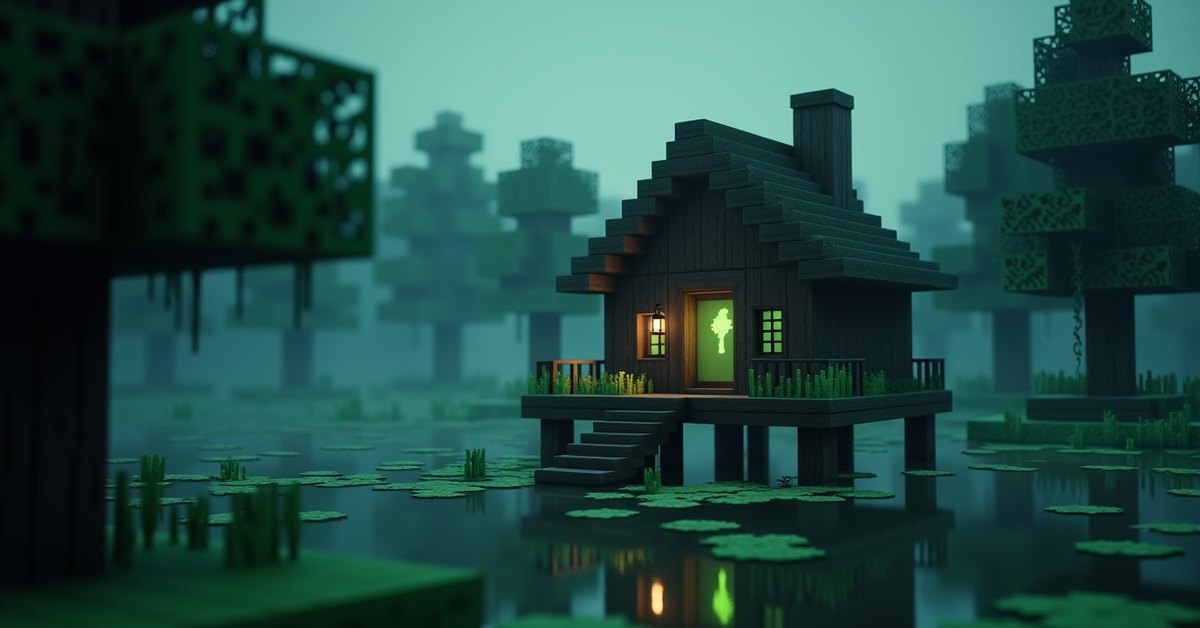
A swamp hut is the small stilted shack you find sitting over the water in swamp and mangrove swamp biomes. Most players call it the witch hut, because a witch lives inside and more keep spawning there long after you clear the first one out.
That constant supply of witches is the whole reason the hut matters. Left alone it’s a spooky bit of scenery. Turned into a farm, it’s one of the easiest renewable sources of redstone, glowstone dust, sugar, gunpowder, and glass bottles in the game.
Here’s how to find one, what sits inside, how the witch spawning actually works, and how to build a farm around it without wasting a week of survival time.
What is a swamp hut?
A swamp hut is a generated structure made almost entirely of spruce wood. It stands on four spruce log stilts that lift a single square room above the swamp, so the floor usually hovers over water or muddy ground. The walls are spruce planks and the roof is built from spruce stairs.
The game treats the hut as a witch spawner. When the structure generates, a witch appears inside it, and the surrounding volume keeps producing more witches under rules that ignore the usual lighting checks. In Java Edition a black cat also generates with the hut and sits nearby.
Inside the room you’ll find three things: a cauldron, a crafting table, and a flower pot holding a red mushroom. The cauldron starts empty. None of the interior blocks are protected, so you can break them and take them if you want a free crafting table and cauldron early on.
Where swamp huts generate
Swamp huts only appear in swamp and mangrove swamp biomes. You won’t find them in any other biome, so the first step is always locating swampland: flat, green-tinted water dotted with lily pads and the occasional oak draped in vines, or the reddish mangrove roots and mud of a mangrove swamp.
They generate on or over the surface, raised on their stilts, which makes them easy to spot from a distance once you’re in the right biome. Fly over a large swamp in creative or scan the shoreline in survival and the dark spruce silhouette stands out against the lighter swamp foliage.
If you’d rather not wander, you can jump straight to one. On Java Edition the command /locate structure minecraft:swamp_hut returns the coordinates of the nearest hut. Bedrock uses /locate structure swamp_hut. Both need cheats enabled on the world.
The witch inside
The witch is why anyone cares about this structure. She throws splash potions of poison, slowness, weakness, and instant damage, and drinks her own potions of healing, fire resistance, and water breathing to survive. Fighting one in melee is awkward because she heals through your hits, so a bow or a quick burst of damage works better.
When a witch dies she can drop glass bottles, glowstone dust, gunpowder, redstone dust, spider eyes, sugar, and sticks. If she’s killed while drinking or holding a potion, she can also drop that potion. Those drops are the reason a witch hut is worth farming rather than clearing once.
Think about how much of that you’d normally have to mine or hunt for. Redstone and glowstone dust are the standouts, since one means a trip underground and the other means a run to the Nether. A working witch hut turns both into something you collect by standing still. Glass bottles and sugar keep your brewing stand fed, and gunpowder covers fireworks and TNT.
How witch spawning works at the hut
A normal hostile mob needs darkness to spawn. Witches at a swamp hut do not. The game reserves a box of space tied to the hut, and inside that box witches spawn as part of the swamp hut’s own spawning rules rather than the standard light-level check. That’s what makes a reliable farm possible: you don’t have to keep the area pitch black.
The catch is that this spawn box competes with every other valid spawn space nearby. Caves under the swamp, dark patches of water, and unlit land all pull spawn attempts away from the hut. If witches trickle out slowly, it’s almost always because mobs are spawning somewhere else in range instead.
Turning a swamp hut into a witch farm
The build is simpler than most mob farms because you’re not creating the spawn conditions, just cleaning up around them. The goal is to make the hut’s spawn box the only place mobs can appear within range of you.
Start by lighting up or removing every other spawnable surface nearby. That means the ground around the hut, the water surface, and, most importantly, any caves underneath. Spawn attempts reach well below the swamp floor, so an unlit cavern down there will steal most of your witches. Slabs, lighting, or a full dig-and-wall pass all work.
Next, build a collection system under or beside the hut. A common approach is to replace the hut’s floor and add a platform where witches spawn, then use water streams to push them into a drop or a killing chamber. Some players push witches off the spawn platform into a small pit and finish them with a sword swing for the extra loot from player kills.
Then AFK at the right distance. Mobs only spawn within a certain range of you and despawn beyond another, so you want to stand close enough for the hut to stay active but far enough that the rest of the area stays quiet. A spot around 24 to 32 blocks from the spawn platform, walled off from other spawns, keeps the hut ticking.
One more detail: the hut still counts against the hostile mob cap. If other monsters are spawning in loaded chunks around you, they eat into the number of witches the game will produce. Lighting the wider area helps your rates as much as lighting the immediate hut zone.
The black cat
In Java Edition, a single black cat spawns when a swamp hut generates and hangs around the structure. Black cats carry a bit of folklore weight in Minecraft: a tamed black cat that wakes you in the morning can occasionally give you a gift. If you want a black cat specifically, a swamp hut is the most reliable place to tame one, using raw cod or raw salmon.
Taming any nearby cat before you start knocking the hut apart is worth doing, since a farm build can crowd or displace it later.
Java and Bedrock differences
The structure itself looks and generates the same way in both editions, and both treat it as a witch spawner with the special light-independent spawning. The clearest difference is the cat: the black cat that generates with the hut is a Java Edition behavior.
The exact size and shape of the witch spawn box differs between editions, which is why farm designs built for one edition don’t always hit the same rates on the other. If you’re following a tutorial, match it to your edition rather than assuming the numbers carry over.
Frequently asked questions
Why is my swamp hut called a witch hut?
They’re the same structure. “Swamp hut” is the internal name; “witch hut” is what players call it because of the witch that spawns there. Both refer to the stilted spruce shack in the swamp.
Do witches keep spawning after I kill the first one?
Yes. The hut is a spawner, not a one-time encounter. As long as there’s room in the spawn box and you’re within range, new witches keep appearing, which is the whole basis for a witch farm.
Can I break the crafting table and cauldron inside?
Yes. The interior blocks aren’t protected. Breaking the cauldron and crafting table gives you both items, which is a handy early-game grab if you stumble on a hut before setting up a base.
Do witch huts only spawn in swamps?
They generate in swamp and mangrove swamp biomes only. If you’re standing in a swamp and can’t find one, it may just be that none generated in that particular patch. Use the locate command to find the nearest one.
Why are my witch farm rates so low?
Almost always because of competing spawns. Unlit caves under the swamp are the usual culprit; they pull spawn attempts and the mob cap away from the hut. Light or seal everything within range and rates jump.
Can other mobs spawn inside a swamp hut?
The hut’s special spawning produces witches. Other hostile mobs can still spawn in dark spaces nearby under the normal rules, but the reserved hut volume is set up for witches.
Worth building around
If you have a swamp anywhere near your base, a witch hut is one of the best returns on a small build you can get early. Clear the caves under it, add a simple platform and a water stream, and you’ve got a steady drip of redstone, glowstone, gunpowder, and bottles without ever mining for them. Tame the cat first.