Updated for Java Edition 26.3 (October 2026).
A flower forest is a temperate Overworld forest of oak and birch trees with the ground covered in flowers: tulips in four colors, alliums, cornflowers, lilies of the valley, lilacs, rose bushes, peonies and more. It is uncommon, but in our sample of 300 Java 26.3 seeds one sat within 2,000 blocks of spawn in 86% of worlds. Come for dyes, bees and honey.
| Dimension | Overworld |
|---|---|
| Where it generates | Temperate lowland, usually bordering rivers and plains, sometimes meadows or the coast |
| How common | 0.6% of the surface in our sample (about 1 block in 155) |
| Distance from spawn | Median 1,137 blocks; within 1,000 blocks in 45% of seeds, within 2,000 in 86% (our sample) |
| Mobs | Rabbits, sheep, pigs, cows and chickens; bees from tree nests; the usual hostile mobs at night |
| Notable blocks | 14 kinds of flowers, oak and birch trees, bee nests, fallen birch trees |
| Structures | Ruined portals, mineshafts underground, abandoned camps (26.3); no villages |
| Climate | Temperature 0.7, downfall 0.8 (the same as a regular forest) |
| Biome ID | minecraft:flower_forest |
| Added in | Java Edition 1.7.2 (The Update that Changed the World, 2013) |
How to find a flower forest
Look along rivers and plains. In our sample, a flower forest’s edge touched a river 36% of the time and plains 31%, with beach (7%), meadow (6%) and ocean (4%) far behind. So the walking route is to follow a river through plains country and watch the tree line: a patch of forest with color all over the ground is the one you want. If you reach a meadow below a mountain, check the lower ground around it too.
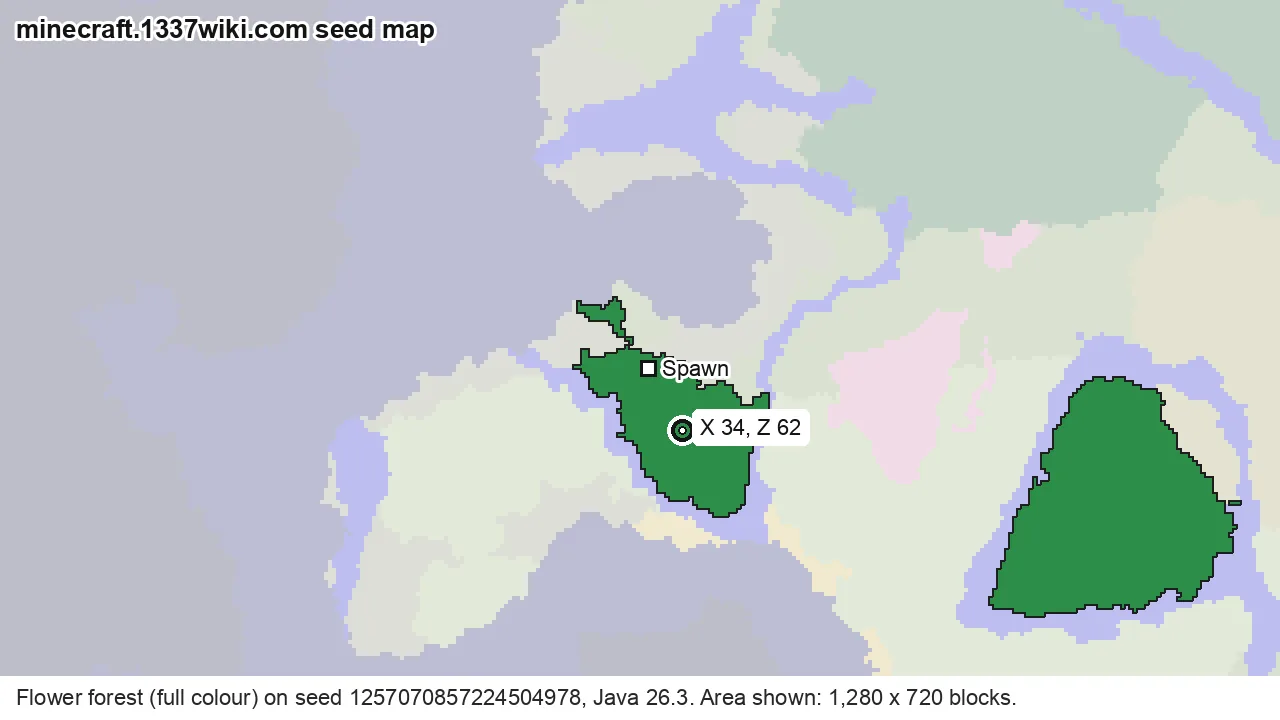
These three Java 26.3 seeds put a flower forest less than 100 blocks from spawn. Each coordinate is inside the biome, checked at block level.
| Seed | Flower forest at | From spawn | Map |
|---|---|---|---|
1257070857224504978 |
X 34, Z 62 | 71 blocks | Open on the map |
6724469410739477448 |
X 38, Z -74 | 47 blocks | Open on the map |
8143390798419981316 |
X 430, Z 286 | 84 blocks | Open on the map |
In a world you already have, type /locate biome minecraft:flower_forest (cheats on) for the nearest one, or paste your seed into the biome finder to see every flower forest around spawn. These are Java seeds; the same number on Bedrock gives a different world.
Is a flower forest rare?
Fairly. In our sample of 300 Java 26.3 seeds it covered 0.6% of the surface, about the same as a meadow or sunflower plains and roughly one eighteenth of the area of a regular forest. It is never missing for long, though: every seed had one within 5,000 blocks of spawn. Here is how it compares with the other flower-heavy biomes:
| Feature | Flower forest | Meadow | Sunflower plains | Forest |
|---|---|---|---|---|
| How common (our sample) | 0.6% of the surface | 0.6% | 0.7% | 11% |
| Median distance from spawn (our sample) | 1,137 blocks | 786 blocks | 1,089 blocks | 126 blocks |
| Trees | Oak and birch | A few lone oaks and birches | Scattered oaks | Oak and birch |
| Flowers | The widest mix, including tall flowers | Wildflowers, cornflowers, alliums and more | Sunflowers plus plains flowers | A few, some of them tall |
| Wolves | No | No | No | Yes |
| Villages | No | Yes | No | No |
| Temperature | 0.7 | 0.5 | 0.8 | 0.7 |
Flowers in a flower forest
Fourteen flowers generate here naturally. The small ones are dandelions, poppies, alliums, azure bluets, red, orange, white and pink tulips, oxeye daisies, cornflowers and lilies of the valley. The tall ones are lilacs, rose bushes and peonies. The small flowers grow in patches by type, so walking across the biome you pass from one color band into the next.
A few flowers never grow here: blue orchids (swamps), sunflowers (sunflower plains), wildflowers (birch forests and meadows) and pink petals (cherry groves).
Dyes and flower farming
Between them, these flowers give you eight dye colors without any mixing: yellow, red, magenta, light gray, orange, pink, blue and white. Use bone meal on a grass block here and the flowers that pop up are drawn from this biome’s own list. Which flower you get depends on the spot, so bone meal grass in a few different places to restock different kinds. Bone meal on a lilac, rose bush or peony drops a copy of that tall flower.
Bees and honey
Bees don’t spawn on their own; they live in bee nests on some of the birch and oak trees, and fly out during the day to visit the flowers. With this many flowers around, a flower forest is an easy place to start a honey farm. Put a campfire under the nest before you harvest, then use a glass bottle for honey or shears for honeycomb, and the bees stay calm. Break a nest without Silk Touch and it drops nothing, and the bees inside come out angry.
What changed in 2025-26
In Wilderness Bound (Java 26.3, September 2026), abandoned camps can generate in flower forests, with a flower forest design. Camp loot can also include an explorer map that points to a flower forest camp.
In Spring to Life (Java 1.21.5, March 2025), fallen trees were added to most forests. In the flower forest only fallen birch trees generate, not fallen oaks, and some are covered in mushrooms or vines.
Source: the official 26.3 and 1.21.5 release notes.
How we measured
The numbers on this page come from our own seed map engine, running Java Edition 26.3 world generation. We generated 300 random seeds and sampled every 16th block across a 10,240 by 10,240 block square centered on each world’s spawn. “How common” is the flower forest’s share of those samples; “distance from spawn” is how far the nearest flower forest sample was. The seeds above were picked from the same run, and each coordinate was re-checked at block level.